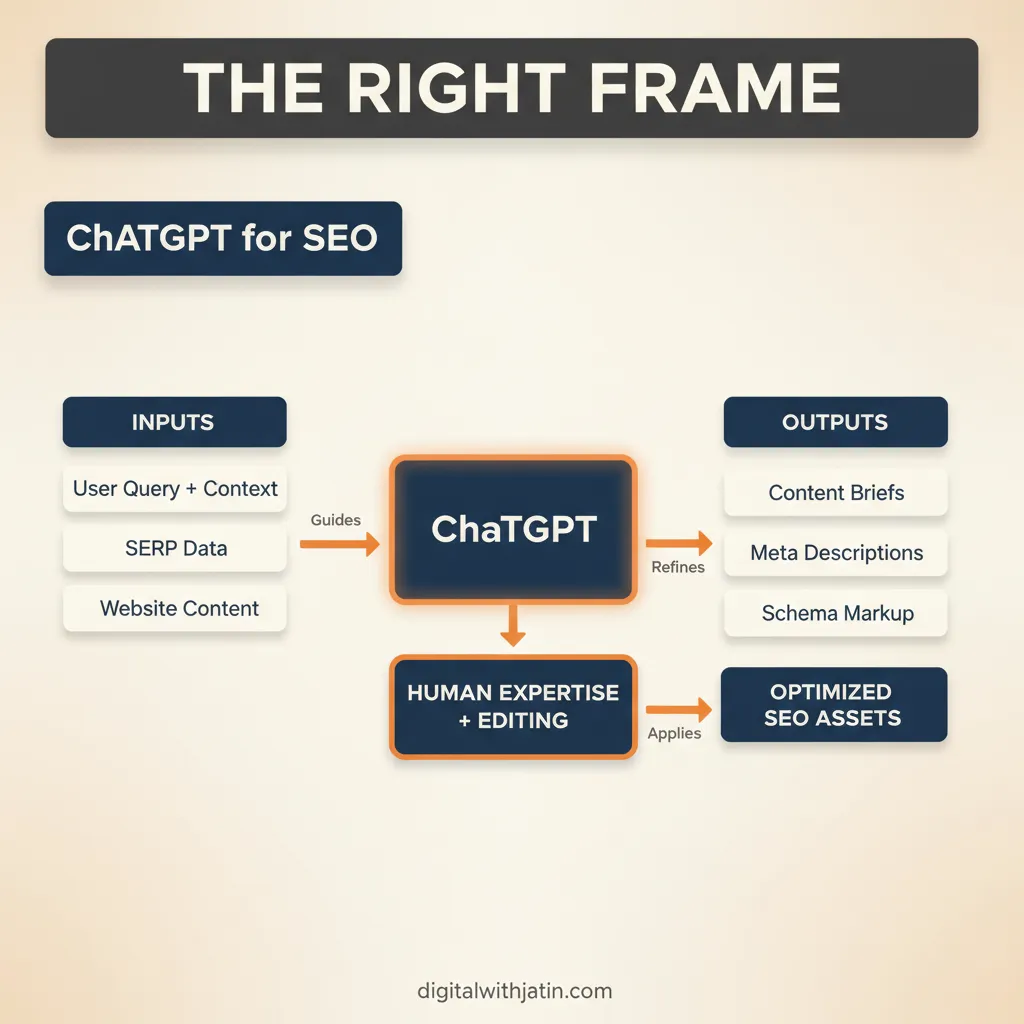
- ChatGPT is useful for drafting, schema generation, FAQ expansion, and content ideation. It is not useful for live keyword data or current rankings.
- It has no access to real-time search data, so using it for keyword research alone will produce stale or fabricated numbers.
- The right workflow pairs ChatGPT with a real keyword tool (Ahrefs, Search Console) and a human editorial pass.
- ChatGPT for SEO works best as a drafting and formatting layer, not as a strategy or measurement tool.
Chat gpt for seo is the frame for this post. Most people using ChatGPT for SEO make the same mistake: they treat it like an SEO tool. It isn’t. It is a text-generation model with an enormous context window and no live connection to search data. Once you set that expectation correctly, it becomes genuinely useful for a specific set of tasks. Get that expectation wrong and you end up with keyword lists full of made-up search volumes and content that reads like it was written by a committee that has never seen a SERP.
Here is the honest breakdown of what ChatGPT does well, where it fails, and how to build a workflow that uses it for what it’s actually good for.
The direct answer on ChatGPT for SEO
Direct answer: ChatGPT is useful for SEO content drafting, schema markup generation, FAQ creation, title and description variants, and content ideation. It is not useful for live keyword data, current rankings, site audits, or any task requiring real-time search information. Pair it with Ahrefs or Google Search Console for anything data-dependent.
If you are currently using ChatGPT as your only SEO tool, you are missing both its strengths and filling your workflow with its weaknesses. The model’s full capabilities are documented at the OpenAI platform overview. Worth reading before you decide how to deploy it.
5 tasks where ChatGPT adds real value
1. First-draft content from a detailed brief
Give ChatGPT a brief with a target keyword, the intended audience, the page’s goal, a word count, and three to five structural notes. It will return a usable first draft in under a minute. The draft still needs a human pass for accuracy, original insight, and voice. But starting from a structured rough draft is faster than starting from a blank document, and the time savings are real on any content volume above five posts a month.
The key word is “detailed brief.” A vague prompt (“write about ChatGPT for SEO”) returns a generic article that will need to be rewritten from scratch. A specific prompt that names the audience, the angle, and the required structure returns something editable.
2. Schema markup generation
ChatGPT is reliable at generating JSON-LD for FAQPage, Article, HowTo, and Product schema types. Give it the content and ask for the schema block. Validate what it returns with the Google Rich Results Test before you publish. The model occasionally misses required fields, but it gets the structure right often enough that generating schema manually is slower.
This is one of the highest-value use cases because structured data is time-consuming to write by hand and easy to get wrong. ChatGPT shortens that loop significantly.
3. Title tag and meta description variants
Give it a URL (or a paste of the content), the focus keyword, and the character limits. Ask for five variants each for the title and description. Pick the best, adjust for voice, done. This works well for batch work, where you need to refresh metadata across 30 pages faster than your team can write them one by one.
4. FAQ generation from existing content
Paste the draft or the live content. Ask for the ten most likely questions a reader would ask after reading it. ChatGPT is good at this. Use the output to build your FAQPage schema set and to find content gaps you didn’t cover in the original draft.
This is especially useful for AI SEO because strong FAQ sections are one of the highest-citation passages in AI Overviews and Perplexity answers.
5. Content ideation and topic clustering
Give it a seed topic and your audience. Ask for 20 subtopics, then ask it to group them into clusters. You will still need to validate the clusters against search data (actual volume, keyword difficulty, intent), but the ideation step is faster than a blank brainstorm. Use it to generate the first list, then filter it through a real keyword tool.
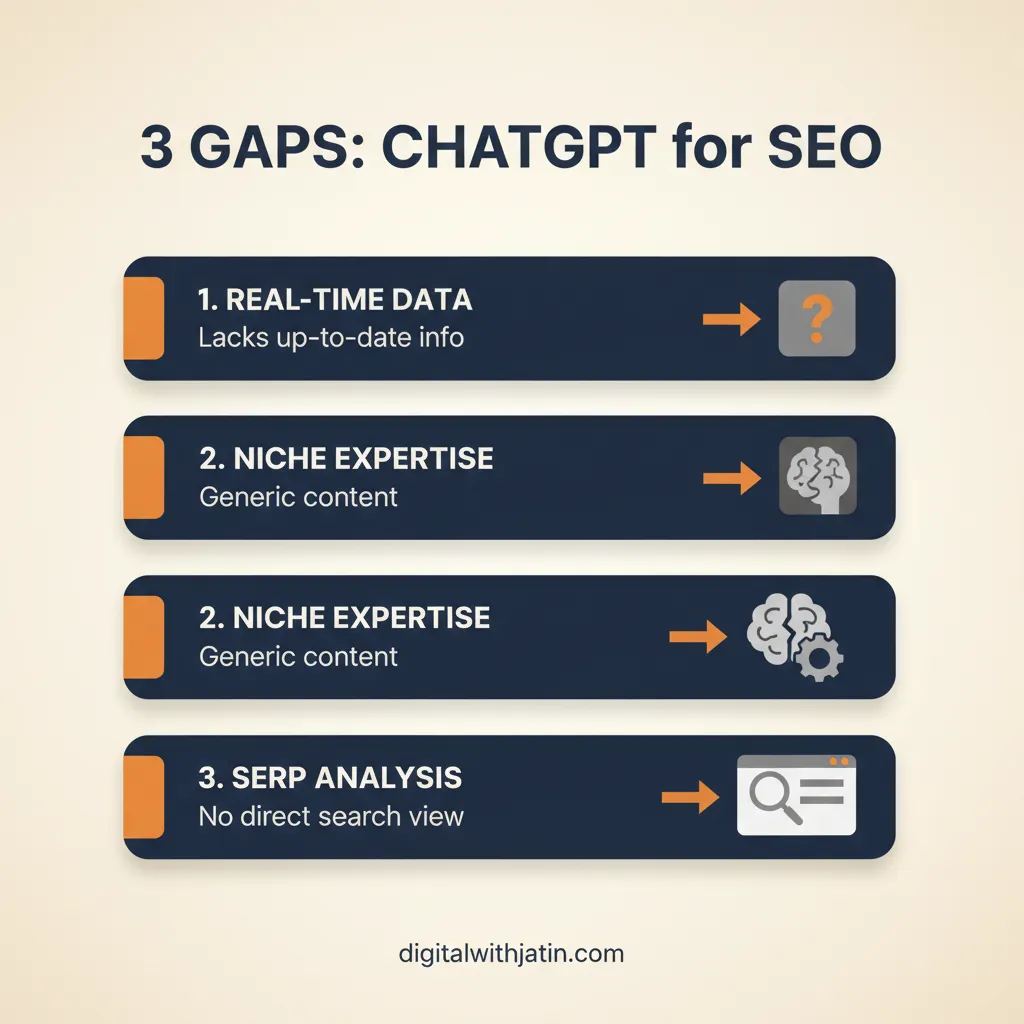
3 gaps where ChatGPT falls short
Gap 1: It has no live search data
ChatGPT does not know what keywords are ranking right now. It does not know your site’s Search Console impressions. It cannot tell you whether a piece of content moved up or down after you published it. Any keyword volume number it gives you without citing a live source is a guess, and in my experience those guesses are consistently wrong enough to mislead decisions.
For anything involving numbers, check against Ahrefs, Semrush, or Google Search Console. There is no substitute.
Gap 2: It cannot audit a site
ChatGPT cannot crawl a URL, check for broken internal links, identify indexation issues, flag Core Web Vitals problems, or verify that your robots.txt is blocking the wrong crawlers. These tasks need a dedicated tool: Screaming Frog, Sitebulb, or a custom crawler. Using ChatGPT for site audits is like asking it to read a map it has never seen.
For the technical side, the work I cover in what AI simplifies in technical SEO is a better starting point than any chat-based workaround.
Gap 3: It has no memory of past performance
ChatGPT cannot learn that your audience responds better to listicles than long-form essays, that your product pages convert better with benefit-led titles, or that a specific content angle failed six months ago. Each session starts fresh. Building institutional SEO knowledge requires systems: a shared brief template, a QC log, a reporting loop. ChatGPT can follow instructions you give it in the session. It cannot carry forward the patterns you have learned over time.
The workflow that actually works
The correct role for ChatGPT in a using chatgpt for seo workflow is as the text layer in a pipeline, not the strategy layer or the measurement layer.
Here is how I run it:
- Keyword research happens in Ahrefs or Google Search Console. Real data only.
- The brief is built by a human (me or a team member) using the research output.
- ChatGPT generates the first draft from the brief.
- A human edits for accuracy, original insight, brand voice, and stat verification.
- Schema markup is generated by ChatGPT, then validated in the Rich Results Test.
- The post publishes with a human sign-off.
- Performance data goes back into Search Console and the keyword tool, not into ChatGPT.
This is similar to the agent workflow I describe in how to use AI agents in SEO, where ChatGPT or Claude handles the drafting and formatting steps while humans and specialist tools handle research, QC, and measurement.
The mistake is collapsing that pipeline. When you ask ChatGPT to do the keyword research, write the brief, draft the post, and evaluate its own output, you get generic content with no data backbone, and you lose the editorial gate that makes the content trustworthy.
FAQ
Can ChatGPT do SEO?
ChatGPT can assist with several SEO tasks: drafting content, generating schema markup, writing title and description variants, and creating FAQ sets. It cannot check live rankings, pull search volume data, crawl pages, or audit a site. It is a text-generation tool, not an SEO platform.
Is ChatGPT good for keyword research?
Only partially. ChatGPT can brainstorm keyword variants and topic clusters from a seed term, but it has no access to live search volume, keyword difficulty, or click-through data. Any numbers it gives you without a cited source should be verified in Ahrefs, Semrush, or Google Search Console before you use them.
Can ChatGPT write SEO content?
Yes, with conditions. ChatGPT can produce a workable first draft from a detailed brief. The draft will need a human editorial pass for accuracy, original insight, and brand voice. Published without editing, most ChatGPT drafts are generic and thin, which is what triggers quality issues, not the AI origin itself.
Does ChatGPT know current rankings?
No. ChatGPT has a knowledge cutoff and no real-time web access in its base form. Even the browsing plugin retrieves a limited number of pages, not a full SERP picture. For current ranking data, use Google Search Console or a rank-tracking tool.
What can ChatGPT not do for SEO?
ChatGPT cannot check live keyword rankings, audit a site for crawl errors, pull current search volume, verify that your schema passes Google’s Rich Results Test, or measure how your content performs after publishing. These tasks require dedicated SEO tools. ChatGPT handles the text layer; everything else needs a specialist platform.
The right frame
ChatGPT for SEO is a production speed tool, not an SEO platform. It removes the blank-page problem from drafting and the manual effort from schema generation. It does not replace Ahrefs, Search Console, or human judgment on what to publish and why.
If you want to see how ChatGPT fits into a broader AI-driven SEO setup, the AI SEO service page covers the full stack I use with clients, including where ChatGPT sits relative to other models and tools in the workflow.