- There is no universal best AI SEO agency. The right one depends on your site's current state, your query types, and whether the agency can show you what 'AI SEO' means in their actual process.
- Six questions cut through the noise: ask for the citation tracking stack, the schema implementation process, the direct-answer content workflow, the crawl policy, the cluster structure method, and the measurement cadence.
- Three red flags: agencies that cannot name their citation tracking platform, agencies that treat AI SEO as a content volume play, and agencies that conflate prompt use with an AI SEO system.
- AI SEO in an agency context should mean measurable citation share, not just AI-generated content.
A prospect emailed me last year asking if I could review a proposal they had received from another agency. The agency was offering “AI SEO” as a service line. The proposal used the term seventeen times. It did not mention citation tracking, passage structure, FAQPage schema, or any platform for measuring AI visibility. What it described was a content production process using ChatGPT, with a promise of faster turnaround.
That is the AI SEO buzzword version. This post is a framework for telling the difference, from the perspective of someone who competes in this space and has to be honest about what the work actually involves.
What Is the Best AI SEO Agency: The Direct Answer
There is no universally best AI SEO agency. The right agency depends on your site’s current technical state, the query types you are targeting, and whether the agency can demonstrate what “AI SEO” means in their actual delivery process. The evaluation framework matters more than any ranking or list.
What “AI SEO” Should Mean in an Agency Context
AI SEO in an agency context should mean two things: (1) using AI tools to make the SEO workflow more systematic and reproducible, and (2) optimizing content for citation in AI-generated search responses (Google AI Overviews, ChatGPT, Perplexity).
The first part (AI in the workflow) is now table stakes. Most agencies use AI tools somewhere in their process. That alone does not make them an AI SEO agency in any meaningful sense.
The second part (citation optimization) is the distinguishing capability. It requires specific technical knowledge: passage-level content architecture, FAQPage schema, direct-answer blocks, named-author Article schema, citation tracking across multiple AI surfaces. Agencies doing this work should be able to describe each element specifically without being prompted.
For context on what the citation layer requires technically, how AI is changing SEO covers the five operational shifts that define the current landscape.
6 Questions to Ask Before Hiring an AI SEO Agency
Question 1: What platform do you use to track AI citation share?
This question has a specific answer. The main platforms as of 2026 are Profound, Otterly, and AthenaHQ. Each tracks citation frequency across Google AI Overviews, ChatGPT, and Perplexity. A credible AI SEO agency uses at least one of them. An agency that responds with “we monitor AI visibility through our proprietary system” without naming a platform is almost certainly not measuring citation share in any rigorous way.
Question 2: Describe your schema implementation workflow.
Specific things to listen for: FAQPage JSON-LD schema generated and validated against the Google Rich Results Test, Article schema with a named author field, BreadcrumbList for site structure context. If the answer is “we add schema when needed” without specifics, that is not a schema workflow. It is a reactive patch.
Question 3: How do you write the direct-answer block for each page?
Every page targeting an informational query should have a 40-60 word direct-answer block in the first 200 words. This is the passage that AI Overviews extract. An agency with a real AI SEO content process can describe exactly how this block is written, where it appears, and how it is checked before publication. If this is the first time they have heard the term “direct-answer block,” that tells you something.
Question 4: How do you handle robots.txt for AI crawlers?
Google-Extended, GPTBot, and PerplexityBot each have separate user agent strings. A site that blocks any of these loses citation potential on that surface. The right answer here is a specific robots.txt for AI crawlers audit and explicit allow directives for each crawler. A vague answer about “not blocking important crawlers” is not a workflow.
Question 5: How do you build the topical cluster for a new client?
AI retrieval systems weight domain-level topical authority. A site with 40 well-structured posts on one subject earns more citation weight than a site with 200 scattered posts. An agency that understands this will describe a specific cluster architecture: a pillar page, a defined set of supporting posts, internal linking structure, and a publication sequence. An agency that describes “publishing lots of content on your topics” is describing volume, not architecture.
Question 6: What is the measurement cadence and what metrics are in the weekly report?
Classic rank tracking remains relevant. It should appear in the report. But it should appear alongside citation share data, showing which queries are generating AI citations, which pages are being cited, and how that is trending week over week. A report that shows only keyword rankings is not measuring the AI visibility layer. For the full picture of how SEO will change with AI, measurement is where most agencies are still catching up.
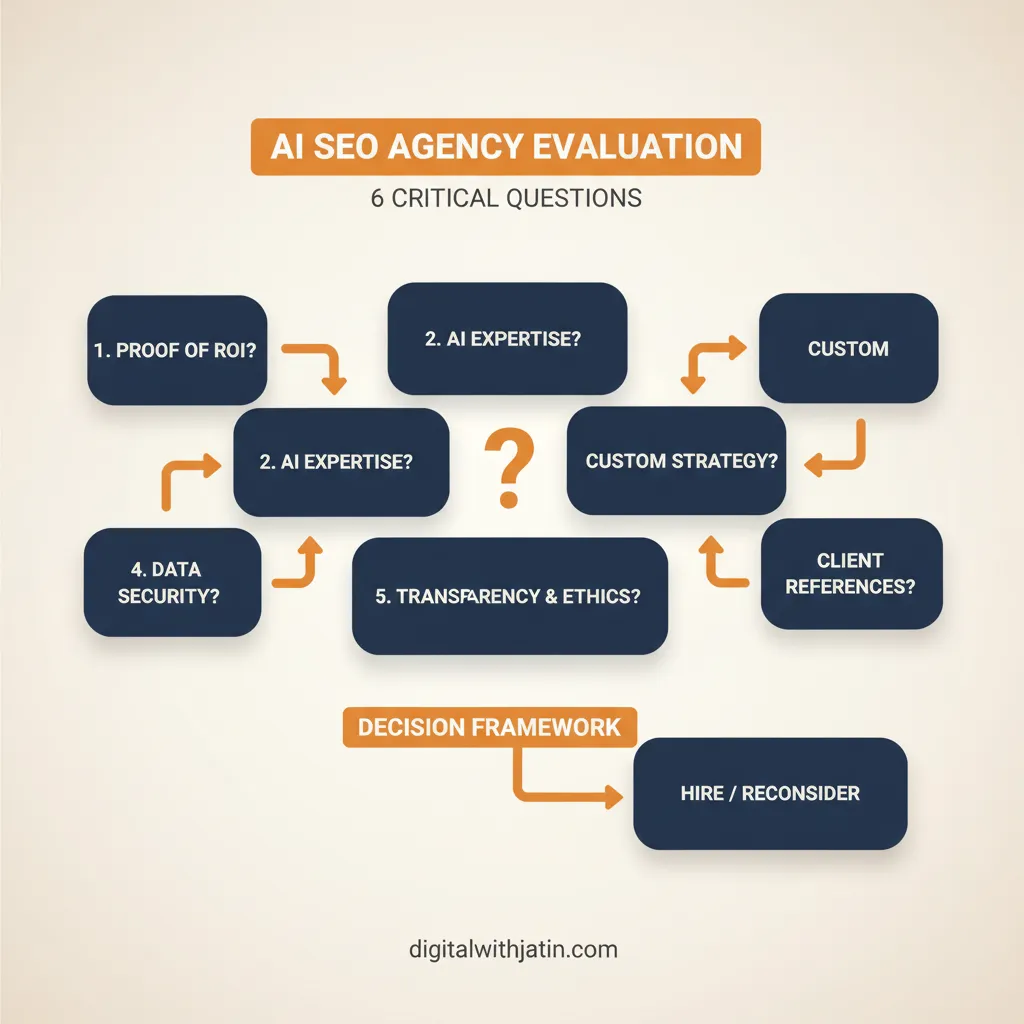
3 Red Flags
Red flag 1: They cannot name their citation tracking platform. There are three main platforms for this (Profound, Otterly, AthenaHQ). If an agency describes measuring AI visibility without naming a specific platform, they are likely using manual spot-checks or not measuring it at all. Citation share data is not something you can generate from Search Console. It requires a dedicated tool.
Red flag 2: They define AI SEO as producing more content faster. Using AI tools to scale content production is a valid workflow. It is not AI SEO in the sense of optimizing for citation in AI-generated responses. An agency that leads with volume (“we can produce 50 posts a month with AI”) without addressing passage structure and citation architecture is selling a content service under an AI SEO label.
Red flag 3: They claim to guarantee AI Overview placement. AI Overviews are not a paid placement. Google does not offer guaranteed positions in AI-generated responses. The system selects passages based on relevance, source authority, and passage quality. Any agency promising guaranteed AI Overview rankings is misrepresenting how the system works. The honest answer is that the right content structure improves citation probability. There are no guarantees.
What to Actually Compare Across Agencies
When comparing agencies, the useful comparison points are:
Deliverables per month. Not vague (“content and SEO support”) but specific: number of posts, schema implementations, citation audits, cluster depth assessments.
Technical scope. Does the retainer include schema implementation, or just content? Does it include a robots.txt audit? Does it include citation tracking setup?
Reporting structure. Does the report include citation share data alongside rank data? How often? What triggers a strategy adjustment?
Case evidence. Not general claims but specific examples: “we implemented FAQPage schema and direct-answer blocks on a client’s top 20 pages and saw citation frequency in AI Overviews increase over 90 days.” Specificity in case evidence correlates with specificity in delivery.
For how the underlying technical layer works, how to use AI agents in SEO covers the workflow architecture that makes systematic AI SEO possible at scale.
FAQ
What should I look for in an AI SEO agency?
Look for three things: a defined citation tracking stack (they should name the platform), a schema implementation workflow that includes FAQPage and Article schema with named authors, and a content process that produces 50-word direct-answer blocks. If they cannot describe these specifically, “AI SEO” is a label, not a practice.
What is the difference between an AI SEO agency and a traditional SEO agency?
A traditional SEO agency optimizes for ranked pages: backlinks, crawlability, keyword targeting. An AI SEO agency adds a citation layer: passage structure, schema for AI retrieval, and citation share tracking. The foundations overlap; the measurement and content architecture differ.
What are red flags when evaluating an AI SEO agency?
Three main red flags: they cannot name their citation tracking platform, they define AI SEO as producing more content faster with AI tools, or they claim to guarantee AI Overview placement. No one can guarantee AI Overview citation. Anyone who says they can is misrepresenting how the system works.
How much does an AI SEO agency cost?
Retainers vary widely based on site size and technical scope. Ask for a scope of work that itemizes deliverables (number of posts, schema implementations, citation audits) rather than a monthly fee without specifics. The fee makes sense only once the deliverables are defined.
Can I do AI SEO myself or do I need an agency?
Most technical requirements for AI citation readiness can be implemented in-house: FAQPage schema, direct-answer blocks, robots.txt crawler allowances. Where agencies add value is in systematic citation tracking, cluster planning, and keeping up with technical changes. Small sites can start with the basics. Larger sites with competitive queries benefit from the systematic approach.
What does AI SEO actually mean in an agency context vs. as a buzzword?
As a buzzword, AI SEO means the agency uses ChatGPT to write content faster. As a practice, AI SEO means measuring citation share across AI search platforms, implementing the schema and content structure that makes pages citable, building topical clusters, and iterating based on citation data, not just rank data.
The proposal I reviewed for that prospect had nothing wrong with it as a content production offer. It would have produced more pages, faster. What it would not have done is get any of those pages cited in AI Overviews, because none of the structural requirements were in the delivery scope.
That distinction, between content volume and citation readiness, is what the best AI SEO agency evaluation comes down to. Ask the six questions. Watch for the three red flags. The agency that can answer specifically has done the work.
If you want to understand what that work looks like in practice before committing to a retainer, my AI SEO service starts with a citation readiness audit that shows exactly where your site stands.