- Google AI Overview citation is a passage-level optimization, not a page-level one. The winning passage beats the ranking page.
- 7 steps: allow Google-Extended, add FAQPage schema, write a 50-word direct answer block, cite primary sources inline, add Article schema with author, use clean heading hierarchy, build topical cluster depth.
- Steps 1 through 4 are the highest leverage. Do those before investing in step 7.
- Rank alone does not guarantee citation. Pages ranked 3-10 earn citations when their passage structure is cleaner than the page ranked 1.
The first time I saw a page ranked 7th get cited in a Google AI Overviews while the page ranked 1st was passed over, I had a client on the phone asking why. The answer was straightforward: the page ranked 7th had a clean 50-word direct answer in the opening, FAQPage schema, and cited a Google Search Central source inline. The page ranked 1st had none of those.
That is the specific mechanic worth understanding. Citation in Google AI Overviews is a passage-level event. Google is not selecting your page. It is selecting a passage from your page. And passage selection follows a different set of signals than the ranking algorithm.
How to Get Into Google AI Overview for SEO: The Direct Answer
Getting into Google AI Overviews requires making specific passages on your page extractable by Google’s AI. The seven actions that raise citation eligibility are: allowing Google-Extended in robots.txt for AI crawlers, adding FAQPage schema, placing a 50-word standalone answer in the first 200 words, citing primary sources inline, adding Article schema with a named author, using clean heading structure, and building topical cluster depth. Steps 1 through 4 are the highest-leverage changes you can make on existing pages today.
Step 1: Allow Google-Extended in robots.txt
This is the access layer. If Google-Extended is blocked, your content is invisible to AI Overviews regardless of how well structured it is.
Check your robots.txt file at yourdomain.com/robots.txt. Look for any Disallow rules that block Googlebot, Google-Extended, or *. If you are using a Cloudflare WAF rule, a plugin, or a CDN setting that blocks unrecognized bots, Google-Extended may be caught in those filters.
The fix is one line: User-agent: Google-Extended followed by Allow: /. Verify the change with Google’s robots.txt tester in Google Search Console.
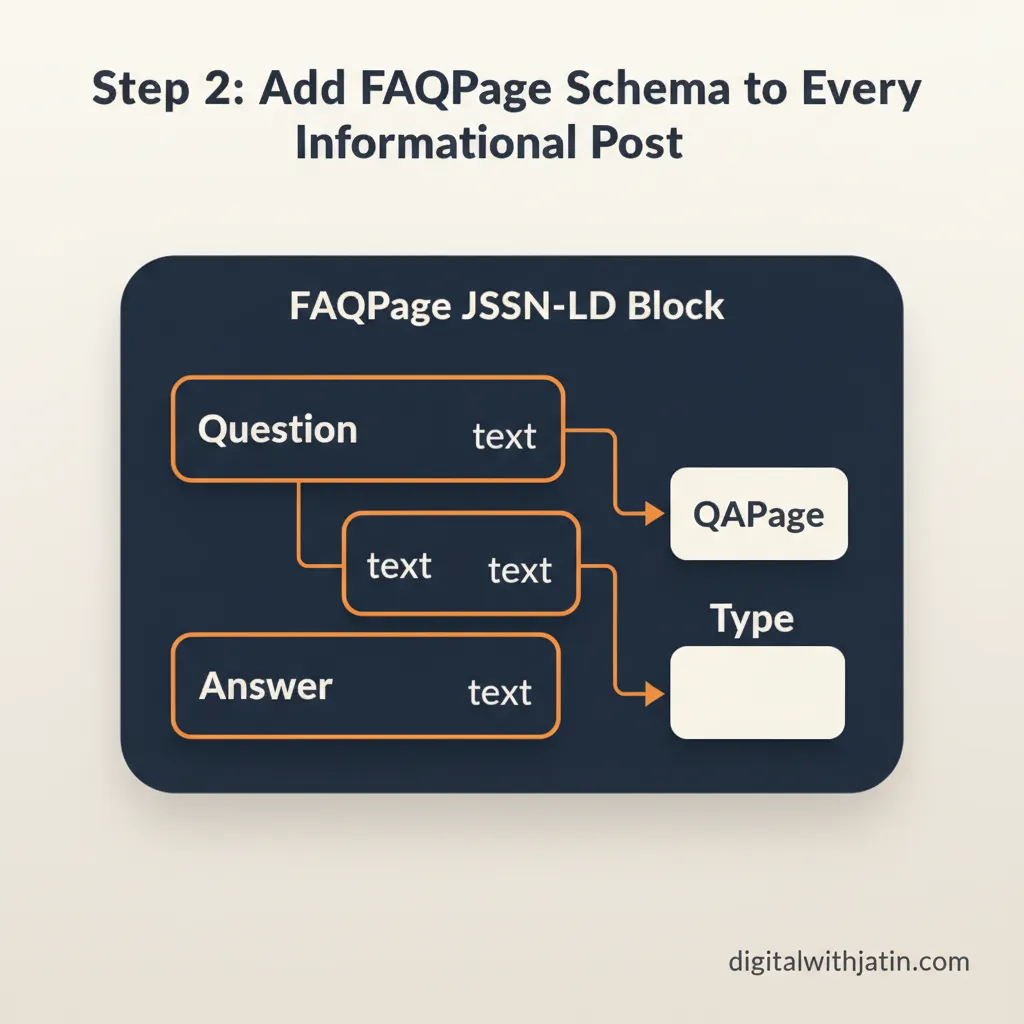
Step 2: Add FAQPage Schema to Every Informational Post
FAQPage JSON-LD is the most direct citation signal available to publishers. Each Q-A pair in the schema is machine-readable as a standalone unit. Google’s AI can pull a single pair without reading the surrounding page.
A valid FAQPage block looks like this:
{
  "@context": "https://schema.org",
  "@type": "FAQPage",
  "mainEntity": [
    {
      "@type": "Question",
      "name": "What is Google AI Overview?",
      "acceptedAnswer": {
        "@type": "Answer",
        "text": "Google AI Overview is a feature that generates a synthesised answer to a search query, citing sources from the web. It appears at the top of some search results pages, above the standard blue links, on informational and research-oriented queries."
      }
    }
  ]
}
Each answer in the schema must be self-contained. No pronouns that refer to the article title. No phrases like “as explained above.” The answer needs to work as a standalone unit pulled into an AI response.
Validate every FAQPage block with Google’s Rich Results Test before publishing.
Step 3: Write a 50-Word Direct-Answer Block in the First 200 Words
This is the passage AI Overviews pull from most often. Within the first 200 words of your post, place a paragraph that directly answers the primary question in 40 to 60 words. No caveats. No preamble. No “it depends” without an immediate resolution.
The structure to follow:
- State the direct answer in sentence 1.
- Add the key condition or qualifier in sentence 2.
- Name the most important supporting detail in sentence 3.
That is the complete block. It should read as a self-contained answer to someone who has not read the rest of the article. If it requires context from the introduction to make sense, rewrite it.
This block is also the most cited element in the how to show up in AI Overviews SEO guide I published earlier in this cluster.
Step 4: Cite Primary Sources Inline for Every Stat
AI systems prefer to cite content that cites others. The reasoning is straightforward: a page that links to primary research is more trustworthy than a page that states numbers without attribution.
For every numeric claim, link to the original source. Not a summary article. Not a tool company’s blog post reporting research. The original study, report, or official documentation.
Google’s Search Central documentation is a primary source. An arXiv preprint is a primary source. A news article reporting on a study is not the primary source: the study itself is.
If you cannot find the original source, remove the number. Unsourced claims weaken the passage, even if the number is accurate.
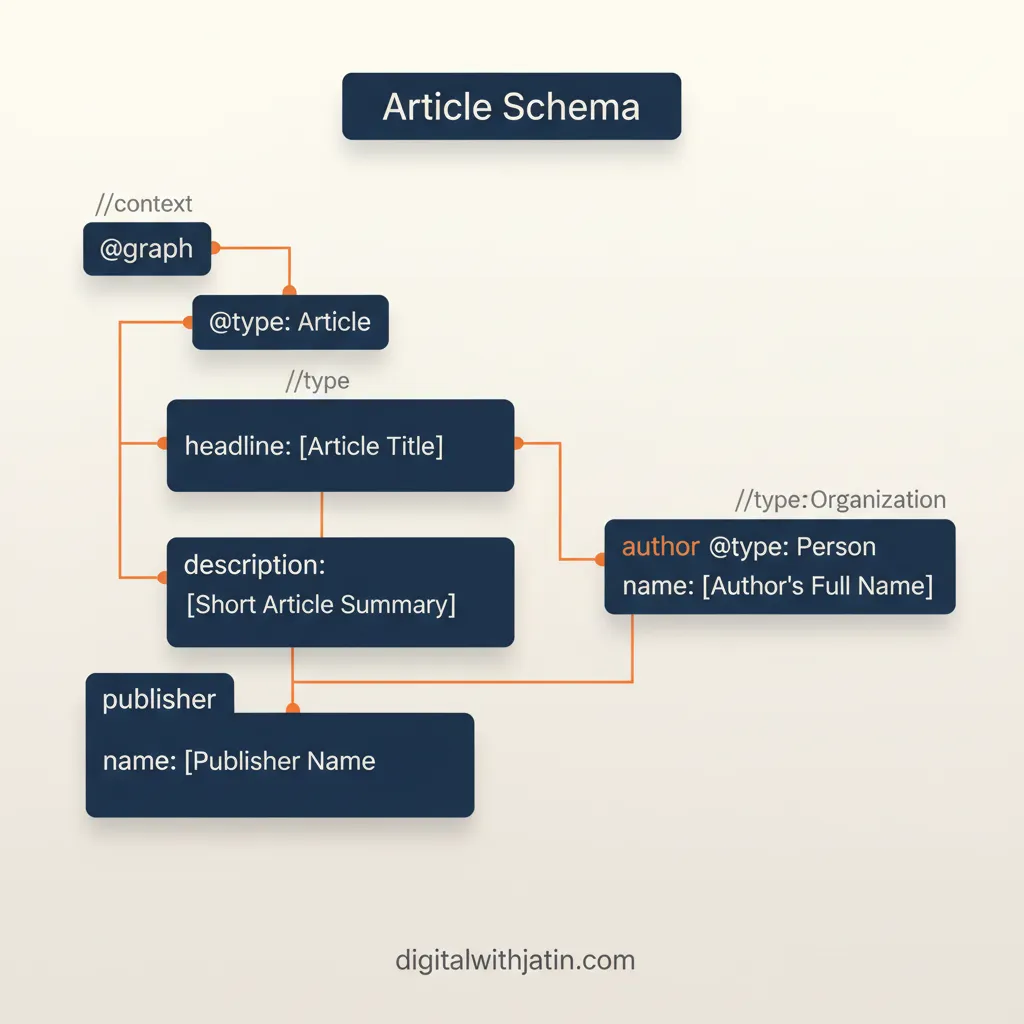
Step 5: Add Article Schema with a Named Author
Article schema contributes two signals: authorship and freshness. Both matter for AI Overview eligibility.
The author entity needs to be a real named person with a verifiable web presence. The schema should include:
author.name(full name, not a brand name)author.url(linking to an about page, author profile, or LinkedIn)datePublished(the original publication date)dateModified(updated with each substantive revision)
Authorship is one of the core E-E-A-T signals Google’s quality rater guidelines describe for evaluating source credibility. Unnamed authors or brand-name bylines score lower on this signal.
Step 6: Use a Clean Heading Hierarchy
One H1 (the post title). H2s for major sections. H3s for FAQ entries, sub-sections, and supporting points. No skipped heading levels. No links inside heading text.
This structural clarity is how AI parsers identify which sections of a page address which questions. A flat wall of text with no heading structure gives the AI no sectioning signals to work with. A well-structured page signals exactly which passage answers which question.
Step 7: Build Topical Cluster Depth
A single well-optimised page competes against sites with 15 posts on the same subject. Topical cluster depth is the signal AI Overviews use to assess whether a site is a genuine authority on a topic, not just a single-post optimisation play.
For the AI SEO cluster, this means publishing posts on related questions, all internally linked, over time. The cluster creates a connected web of authority on a subject. AI search systems recognize this the same way the classic Google algorithm recognizes a topical authority site.
You do not need 50 posts. Eight to ten well-structured posts on related questions, interlinked with clear anchor text, is enough to signal topical authority on a focused subject.
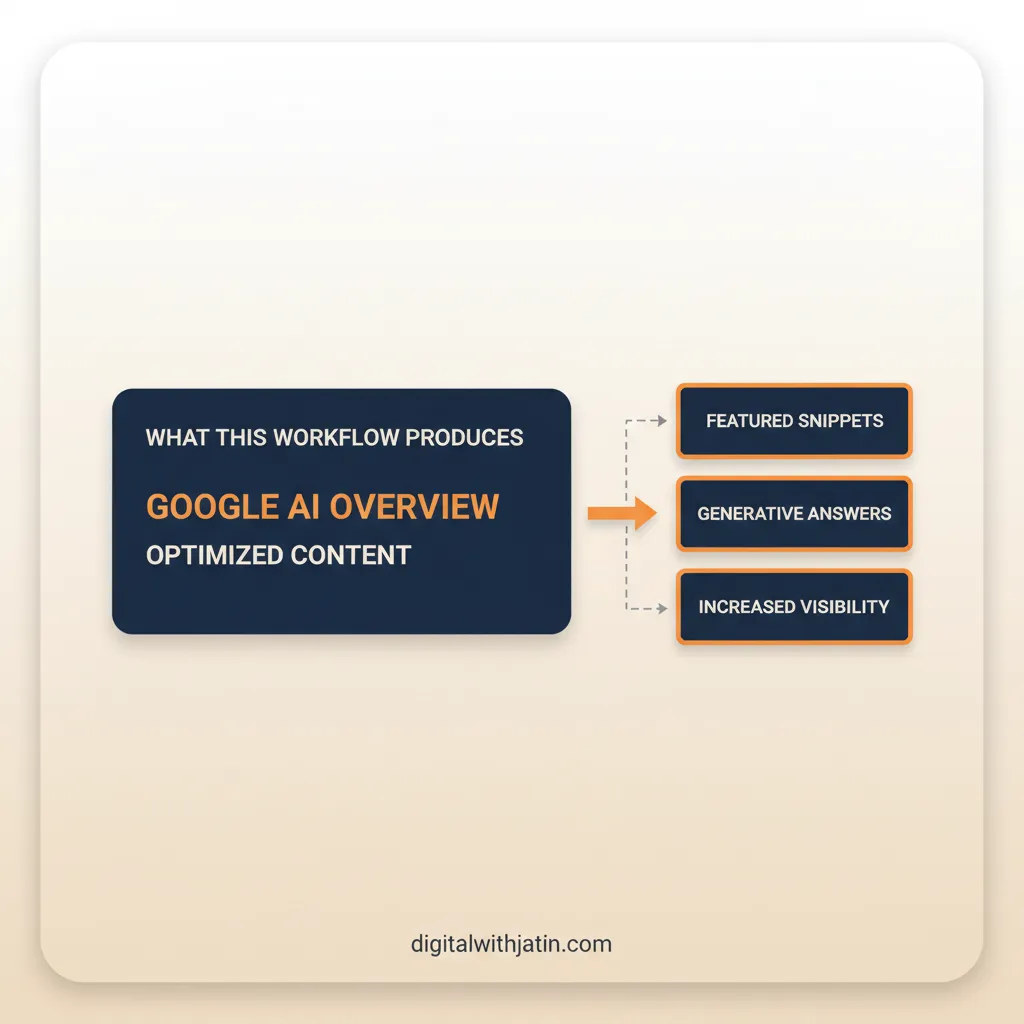
What This Workflow Produces
Running steps 1 through 7 on a set of pages produces three measurable outcomes:
- Pages become eligible for AI Overview citation (previously ineligible due to access or structure issues).
- Citation share increases over 60 to 90 days as Google re-indexes the updated pages.
- Branded search volume often stabilises even on queries where generic CTR drops, because AI Overview citations drive brand recognition without a click.
The measurement layer for this work is citation share tracking, not rank tracking. Rank tells you where you appear in the standard results. Citation share tells you whether you appear in the AI layer. Both matter. For informational query traffic in particular, the citation layer is now where a meaningful share of visibility lives.
The AI SEO overview connects this to the broader strategy. The AI SEO automation service is where I implement these steps for sites that want the process handled end-to-end.
FAQ
How do I get my site into Google AI Overviews?
Seven actions raise citation eligibility: allow Google-Extended in robots.txt, add FAQPage JSON-LD, write a 50-word standalone direct-answer block in the first 200 words of each post, cite primary sources inline, add Article schema with a named author, maintain a clean heading hierarchy, and build topical cluster depth. Steps 1 through 4 have the highest direct impact.
Does ranking number 1 guarantee AI Overview citation?
No. Ranking in position 1 increases eligibility, but Google AI Overviews also cite pages ranked 3 through 10 when their passage structure is cleaner. A page ranked 4 with a clear 50-word direct-answer block and FAQPage schema frequently gets cited over a page ranked 1 without those signals.
What schema markup helps with AI Overview inclusion?
FAQPage schema is the single most direct signal because it makes individual Q-and-A pairs machine-readable. Article schema contributes authorship and freshness signals. HowTo schema helps procedural content. All three can be combined on a single page. Validate each with the Google Rich Results Test after adding.
How long does it take to appear in AI Overviews after optimization?
There is no fixed timeline. Google recrawls content on its own schedule, and AI Overview citation is not triggered by a manual submission. Most practitioners observe a window of 2 to 8 weeks between optimization and first citation on new pages. Existing pages with established crawl frequency may update faster.
Can a new site get cited in AI Overviews?
Yes, but topical authority matters. A new site with 1 post rarely gets cited over an established site with 20 posts on the same topic. Focus first on the technical and structural steps (1 through 6), then build the cluster over 60 to 90 days. Authority accumulates from the cluster, not from individual posts.