- AI SEO is optimizing for passage citation in AI Overviews, ChatGPT, and Perplexity. Not just classic rank position.
- 12 tactics ordered by impact: direct-answer blocks, primary-source citations, named entities, standalone FAQ entries, paragraph caps, comparison tables.
- All three AI search surfaces share the same crawl and index foundation as classic SEO. The work compounds, not competes.
- Add an AI search citation tracker to know whether the tactics are working; rank alone no longer tells the full visibility picture.
A pattern I keep seeing on client work: the page with the better backlinks, the better Search Console numbers, and the better content does not get the AI Overview citation. A weaker page does. That gap is the exact problem AI SEO is designed to close. The question of whether SEO will be replaced by AI misses the more useful one underneath it. Ranking #1 no longer guarantees you are seen. Being cited inside an AI answer does.
This guide is the playbook I use on every page I publish, to earn that citation.
Here’s what you’ll learn:
- What AI SEO actually means, defined against AI Overviews, ChatGPT, and Perplexity
- The four signals AI search systems use to pick a source
- 12 specific tactics that earn citations, with primary sources
- How AI is changing SEO per surface, with platform-specific notes
- What an AI SEO agency or AI SEO company cannot fix for you
What is AI SEO?
Direct answer: AI SEO is the practice of optimizing content and infrastructure to be cited inside AI search experiences (Google AI Overviews, ChatGPT search, Perplexity, and Bing Copilot) alongside ranking in classic SERPs. The unit of success shifts from a page rank to a passage citation.
The phrase covers content, technical, and link-graph work. Each layer feeds the same goal, which is making your page the easiest passage for an AI system to lift, attribute, and trust. The classic SEO foundation does not go away. It just gets a second set of judges sitting on top of it.
Why this matters now
AI Overviews are not a niche experiment. Google announced the general rollout in its May 2024 Search announcement, and prevalence has moved fast since. According to the Semrush AI Overviews study, AI Overviews triggered on 6.49% of queries in January 2025, peaked near 24.61% in July 2025, and settled at 15.69% by November 2025. That is a substantial and growing share of the queries you already track.
ChatGPT search shipped its live web tool in late 2024. Perplexity processed 780 million queries in May 2025, with the CEO citing 20% month-over-month growth at the time. Each of these surfaces sits between the searcher and the website, and each one cites sources differently.
Three things flow from that.
First, the click is no longer guaranteed. A user reading the AI Overview answer may never visit the cited page. The brand mention itself becomes the win.
Second, the citation graph is the new ranking. Whether a page appears as [1] in a Perplexity answer or as a footnoted source in ChatGPT depends on how easily the system can attribute the claim back to you.
Third, the work compounds. The same structured data, primary-source citations, and clean passages that AI search rewards are also what classic SEO has always rewarded. There is no fork in the road, just an additional layer of judges. This is the framing for how AI is changing SEO across every level of the stack.
AI SEO vs classic SEO
The two are not opposites. They share a foundation. The differences sit in what each one optimizes for once the page is indexed.
| Dimension | Classic SEO | AI SEO |
|---|---|---|
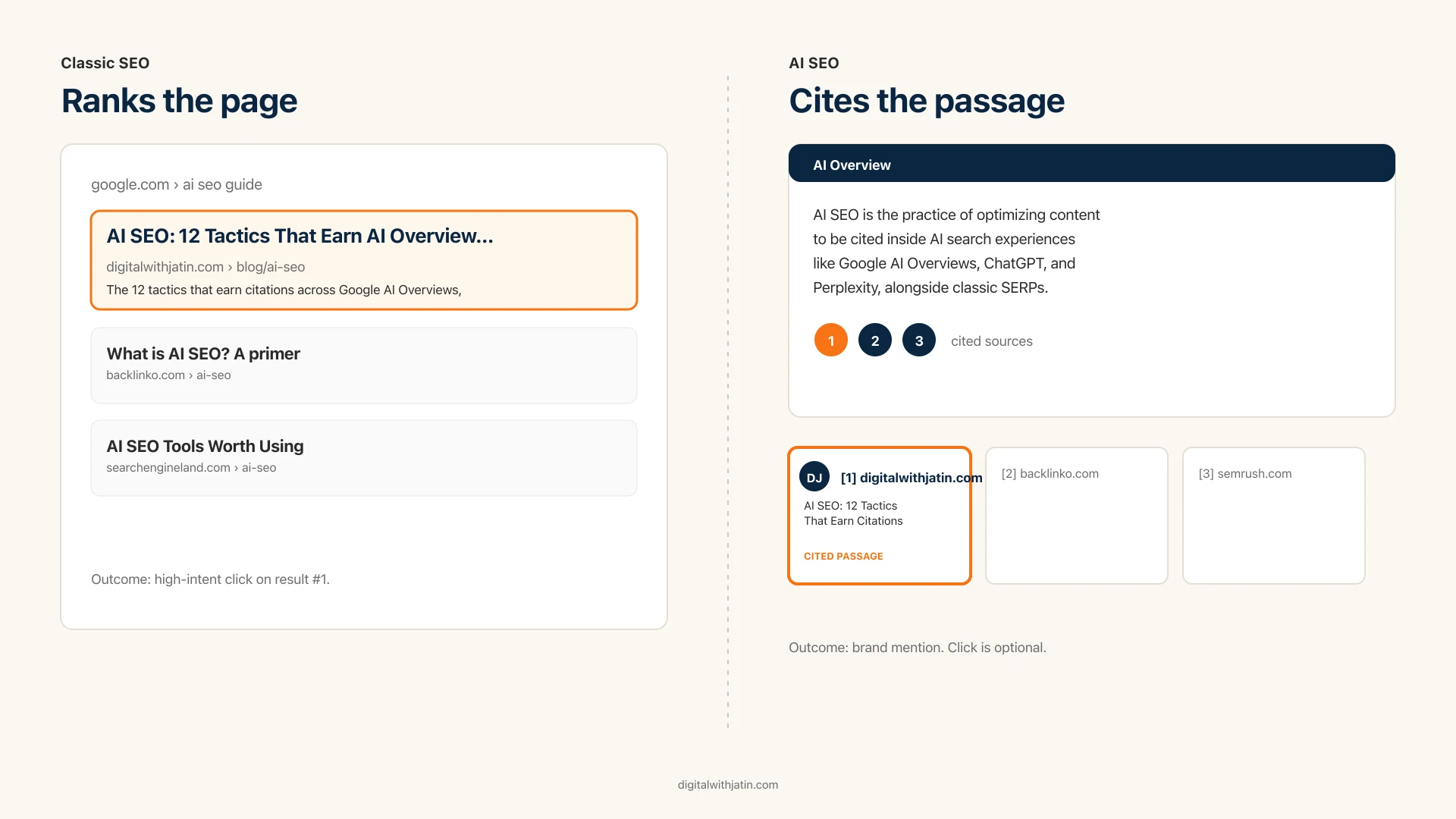
| Unit of success | Ranked page | Cited passage |
| Primary signal | Backlinks plus relevance | Source authority plus passage clarity |
| Crawler | Googlebot | Googlebot, GPTBot, ClaudeBot, PerplexityBot, Google-Extended |
| Visibility check | SERP rank tracker | AI search visibility tracker |
| Click outcome | High intent click | Brand mention, sometimes a click |
| Content shape | Long-form authority | Long-form plus 50-word direct-answer blocks |
| Structured data | Article, FAQ, HowTo | Same, plus llms.txt and explicit named-entity tagging |
Read the table this way. Every classic SEO foundation still matters. The new layer is passage-level engineering inside the page.
The practical effect on a content brief is small but specific. You still target a primary keyword. You still write 1,500 to 2,500 words. The change is that the first 200 words now contain an explicit, scannable answer block, every numeric claim carries an inline citation, and the FAQ section is built to be lifted whole into a Perplexity answer.
If you currently do classic SEO well, much of the foundation transfers directly. The remaining work is what this guide covers. The cluster on whether SEO will be replaced by AI goes deeper on that philosophical side.
The four signals AI search uses
AI search systems do not have a public ranking algorithm document. What they do have is the Google Quality Rater Guidelines (PDF), the published Bing webmaster guidance, and observable behavior across thousands of queries. From those, four signals stand out.
1. Source authority
Authority means the domain has a track record on the topic. Topical authority beats domain authority for AI SEO. A 50-page site that only writes about technical SEO will be cited above a 5,000-page generalist marketing blog when the query is technical. This is why AI SEO fundamentals start with topical depth before anything else.
2. Passage clarity
Each AI answer is built from passages, not pages. A clean passage has one claim, one sentence of evidence, and one citation. Walls of text get skipped. The retrieval embedding cannot find a unit to lift. This is why direct-answer blocks and FAQ entries earn so many citations.
3. Named entities
AI search resolves “Backlinko” or “Search Engine Journal” as a knowledge-graph entity, not a string. Pages that name entities explicitly, instead of using vague references like “this expert” or “a leading SEO blog,” become more citable. The retrieval system can confirm the entity exists and weight the passage higher.
4. Freshness with a date anchor
A passage dated April 2026 outranks an undated equivalent. AI search has no reliable way to confirm when content was written unless you tell it. Date the post in frontmatter, date specific stats inline, and update both when the underlying claim changes.
These four signals show up again in every tactic that follows.
12 tactics that earn AI SEO citations
Each tactic below is one specific change you can ship this week. The list is ordered by impact, highest first. For the underlying mechanics, see the GEO & AEO service page.
Tactic 1: Place a 50-word direct-answer block in the first 200 words
This is the single highest-impact move. Every post earns a paragraph that answers the post’s core question in 50 to 60 words, no marketing voice, no hedging. Place it as the first paragraph under the first H2. AI Overviews and Perplexity quote this block more often than any other passage on the page.
Tactic 2: Cite a primary source for every numeric claim
The Aggarwal et al. GEO arXiv paper reports that GEO techniques, including primary-source citation and quotation, can boost generative-engine visibility by up to 40% on their GEO-bench evaluation. Inline citations turn your page into a more attributable source than one that asserts numbers without backup. The rule is simple. If a sentence has a number, the next thing is the source.
Tactic 3: Tag named entities explicitly
Write “Backlinko’s GEO guide” instead of “a leading SEO blog post.” Write “Google Search Console” instead of “the search console tool.” The named entity is what the retrieval system uses to confirm the passage is on-topic. Do this once per major entity per post, not on every mention.
Tactic 4: Build the FAQ section as standalone passages
Each FAQ answer should make sense on its own, lifted out of context. Write the answer assuming the reader has not seen the rest of the post. Add the FAQPage schema, of course, but the bigger win is that a Perplexity answer can quote your FAQ entry verbatim and have it work.
Tactic 5: Keep paragraphs to four sentences
Long paragraphs hide good passages. The retrieval embedding scores a tight three-sentence paragraph higher than a sprawling six-sentence one because the unit of meaning is contained. In the AI Overview citations I have audited across client sites in early 2026, the cited passage is almost always under five sentences.
Tactic 6: Use comparison tables for “X vs Y” queries
AI answers love tables. A comparison query gets answered with a table whenever the source has one. Write the table with clean column headers, full sentences inside cells where possible, and the primary keyword in the surrounding text. The table itself becomes the cited unit.
Tactic 7: Allow GPTBot, ClaudeBot, and PerplexityBot in robots.txt
Default robots.txt configurations sometimes block AI crawlers. Allow them explicitly. If your business stance is to allow AI grounding but block AI training, allow Google-Extended and PerplexityBot, and decide on GPTBot based on your view of OpenAI training. The policy is yours, but the file must reflect it.
Tactic 8: Add Article and FAQPage JSON-LD
Structured data tells AI search what each block on the page is. The Article schema labels the canonical content. The FAQPage schema marks the FAQ block as a standalone answer set. Both feed retrieval. Validate every page with the Google Rich Results Test before pushing it live.
Tactic 9: Anchor every page to a date
Date the post in frontmatter, in the byline rendered to readers, and inside any time-sensitive claim. “AI Overviews appeared on 15.69% of queries as of November 2025” outperforms the same sentence without the date. AI search uses the date to weight freshness against older content.
Tactic 10: Maintain an llms.txt at the site root
The llms.txt standard is not officially supported by any AI lab yet. It costs almost nothing to publish. List your most authoritative pages, with one sentence each, and link the file from the homepage. Treat this as a belt-and-braces play, not a guaranteed citation lever, and revisit it as the standard matures.
Tactic 11: Build internal-link graphs that cluster around entities
A pillar page links down to every cluster. Every cluster links up to the pillar and across to two or three siblings. The graph itself is a signal of topical depth. AI search systems that crawl this graph see a coherent body of work, not isolated posts.
Tactic 12: Track citations, not just rankings
Add an AI search visibility tracker. Profound, Otterly, and AthenaHQ are three options as of early 2026. Watch which queries cite you, then use the data to find passages that earn citations and write more of them.
Without this measurement loop, AI SEO is guesswork. Operators tracking AI visibility need this feedback loop before tactical bets compound or fail.
Per-platform tactics: AI Overviews vs ChatGPT vs Perplexity
Each surface has its own bias. Backlinko’s GEO guide covers the broad pattern, and the same primary signals show up across platforms even when the weighting differs.
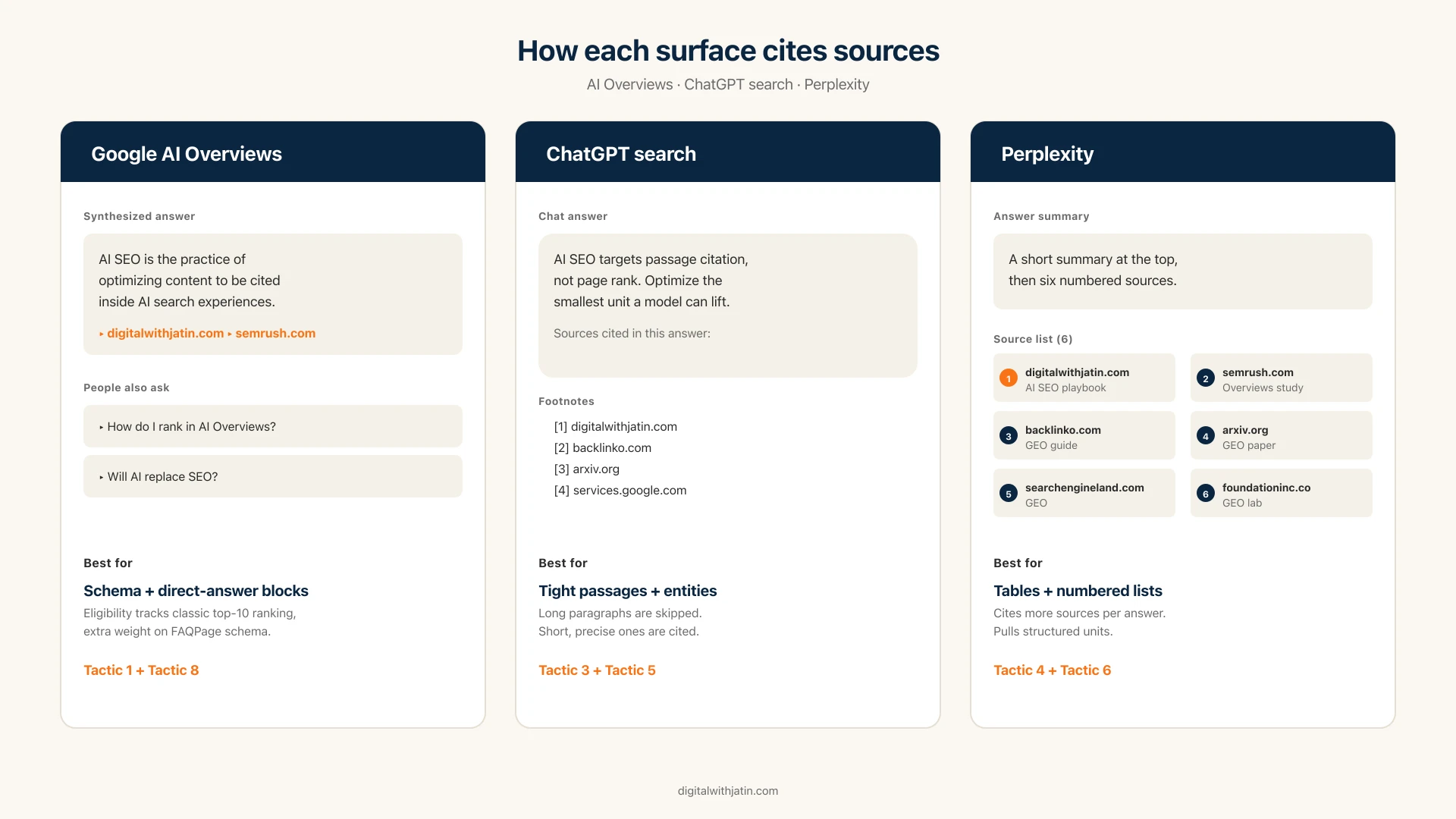
Google AI Overviews lean toward established domains and structured data. The same E-E-A-T signals that win classic search win here, with extra weight on FAQ schema and direct-answer blocks. If you already rank in the top 10, you are eligible for the Overview citation. Tactic 8 (Article and FAQPage schema) and tactic 1 (direct-answer block) matter most. This is also where AI Overview optimization gets concrete.
ChatGPT search prefers tightly scoped passages with explicit attribution. Long, comma-spliced paragraphs get skipped. Short paragraphs with named entities and dated stats get cited. Tactic 3 (named entities) and tactic 5 (paragraph cap) matter most.
Perplexity rewards numbered lists and comparison tables, and it cites more sources per answer than the other two. The numbered tactic list above is engineered specifically to be quotable by Perplexity. Tactic 6 (tables) and tactic 4 (standalone FAQ) matter most.
The shared foundation is the same across all three. The marginal optimizations differ. An AI SEO agency or AI SEO company that treats them as one surface will lose citation share to a team that treats them as three.
What this work will not do for you
AI SEO will not fix a brand with no track record. AI search systems weight source authority heavily, and a domain with three months of content cannot outrank a domain with five years on the same topic. It will not invent citations either. If you have no original observations, no first-party data, and no expert quotes, no amount of schema fixes the gap. The honest answer to “will seo be replaced by ai” is that AI raises the floor on quality, it does not lower it.
It will also not replace human judgment on positioning, voice, or strategy. Agents draft and audit. A human still writes the brief, picks the angle, and decides what to publish.
FAQ
What is AI SEO?
AI SEO is the practice of optimizing content and infrastructure to be cited inside AI search experiences (Google AI Overviews, ChatGPT, Perplexity, and Bing Copilot) alongside ranking in classic SERPs. The unit of success shifts from a page rank to a passage citation.
Will AI replace SEO?
No. AI search surfaces still pull from indexed pages, structured data, and citation graphs. The visibility unit changes, not the foundation. Classic SEO ranked pages, AI search cites passages. Both run on the same crawl and index foundation, so the work compounds rather than competes. This is why “will seo be replaced by ai” is the wrong frame, and why an AI SEO agency that abandons classic SEO under-serves clients.
How do I rank in Google AI Overviews?
Optimize for passage citation. Place a 50-word direct answer in the first 200 words, attach Article and FAQPage structured data, cite primary sources, and ensure the page is crawled by Googlebot and Google-Extended (the AI training crawler). The per-platform tactics section above is the shortest path.
What tools do I need for AI SEO?
Three categories. A classic SEO tool (Ahrefs, Semrush, or Search Console), an AI search visibility tracker (Profound, Otterly, AthenaHQ), and a structured-data validator (Google Rich Results Test). The classic tools surface the keyword and link layer. The AI trackers measure citation share. An AI SEO company without that third leg is missing the only loop that tells you whether your changes worked.
How is AI changing SEO in practice?
The practical answer to how is ai changing seo is that the unit of optimization shrinks from page to passage, the audience grows to include retrieval models alongside Googlebot, and the measurement layer adds citation share to keyword rank. Topical depth, source authority, and clean structure matter more than ever, and thin content gets filtered earlier in the pipeline.
The 12-tactic playbook at a glance
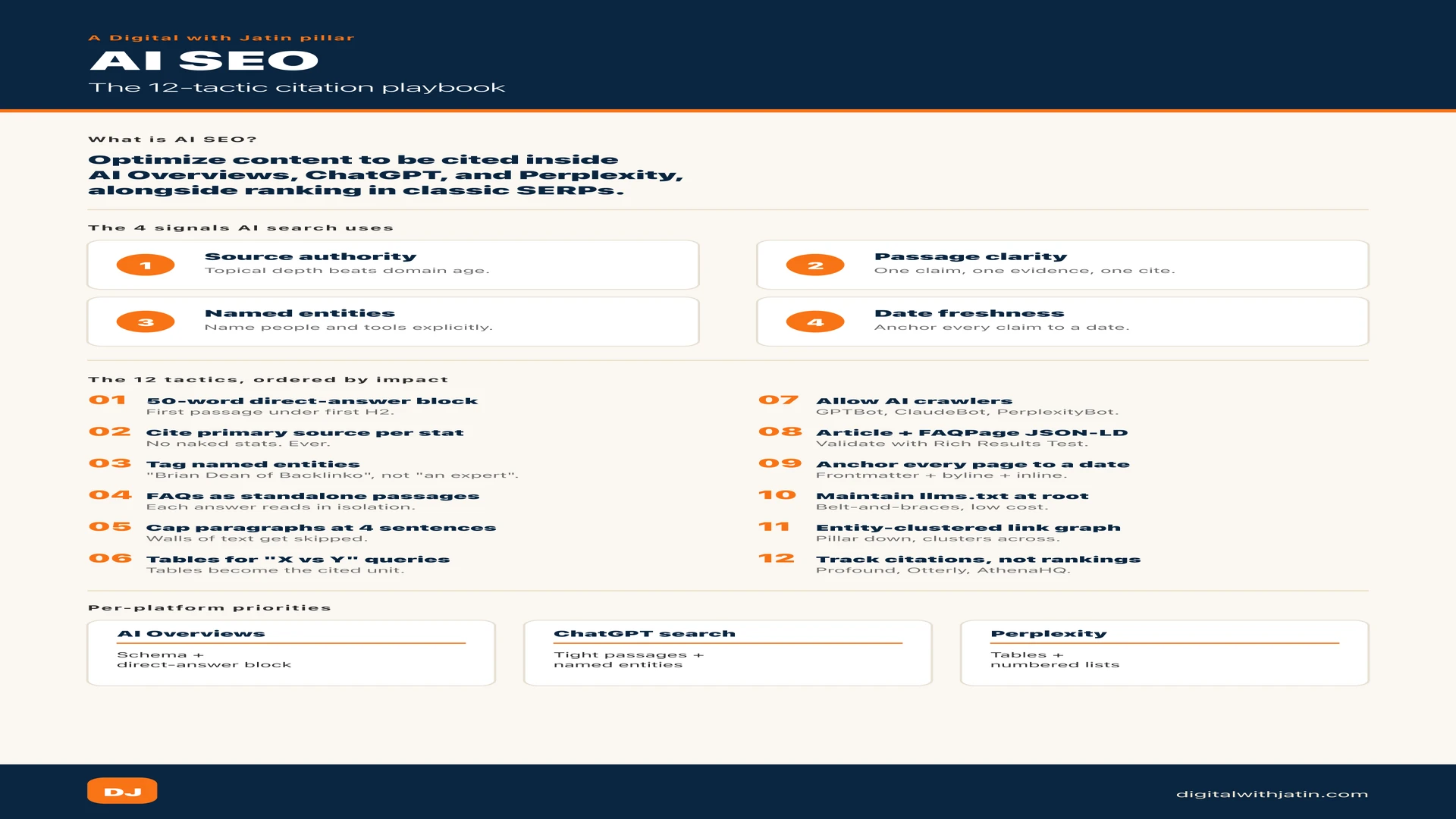
Save the infographic above for reference. It captures the full playbook on one canvas, designed to be pinned, shared, or printed without losing the source attribution.
The pattern from the opening, the better page losing the citation to a weaker one, is reversible. The page that lost the citation can be rewritten. Add the direct-answer block, replace vague references with named entities, cite a primary source for every number, then ask Search Console to recrawl.
That is what AI SEO earns when the work is specific, not philosophical. If you want help applying these tactics on a live site, the GEO & AEO service is where I take clients through the process end to end.