- AIO stands for AI Overview — Google's AI-generated summary block at the top of SERPs.
- AI Overviews pull from Google's existing crawl and index — no separate index to optimize for.
- Getting cited in an AI Overview requires passage-level clarity, structured data, and source authority.
- ~13% of queries trigger AI Overviews per Semrush; commercial and informational queries show different rates.
A client’s site held the number-one spot for a target query for eleven months. Then, in June 2024, a new block appeared above their result. The AI Overview gave users the core answer before they ever saw the organic listing. Impressions held steady. Clicks dropped 22% inside four weeks. The client wanted to know what had changed and, more to the point, what to do about it. Understanding what is AIO in SEO is the first step toward answering that question. This post covers the definition, the mechanics, and the four actions that affect whether your pages get cited.
If you want the broader strategic picture, the AI SEO guide covers how AI Overviews fit inside a full generative search strategy.
What Is AIO in SEO?
Direct answer: AIO stands for AI Overview. It is the AI-generated summary block that Google places above organic results for certain queries. Launched to all US users in May 2024, AI Overviews pull from Google’s standard crawl and index, then display three to five inline source citations alongside the generated text.
The term “AIO” is informal shorthand used across SEO communities. Google’s official product name is “AI Overview,” and the feature replaced what Google previously called Search Generative Experience (SGE) during the 2023-2024 testing period.
What AIO Actually Means for Your Pages
When Google generates an AI Overview, it does not pull from a separate AI index. The retrieval process works against the same crawl and index that powers standard organic rankings. Google’s systems identify passages from indexed pages that match the informational intent of a query, then synthesize those passages into a fluent answer.
Google’s May 2024 announcement confirmed that AI Overviews are built on the same infrastructure as core Search. That matters for SEO because it means there is no separate submission process and no hidden API to tap into. If Googlebot and Google-Extended can crawl your page, and if the page contains a clear, passage-level answer, it is eligible for citation.
Three factors influence which pages Google selects as citations. First, Google looks for a direct-answer passage, typically one paragraph of 50-70 words that addresses the query without requiring the reader to scroll for context. Second, structured data helps Google parse the named entities and relationships on the page. FAQPage and Article schema are the most commonly cited formats in AIO source panels. Third, source authority still matters. Pages with verified author credentials, primary source citations, and E-E-A-T signals aligned with Google’s quality rater guidelines are more consistently selected.
One important note: blocking Google-Extended in robots.txt does not block Googlebot. However, some site owners who blocked Google-Extended to opt out of AI training have observed reduced AIO citation frequency. If AIO visibility is a goal, allow both crawlers.
Which Queries Trigger AI Overviews
Not every query produces an AI Overview. According to Semrush research, AI Overviews appear on approximately 13% of all keywords. The rate varies significantly by query type.
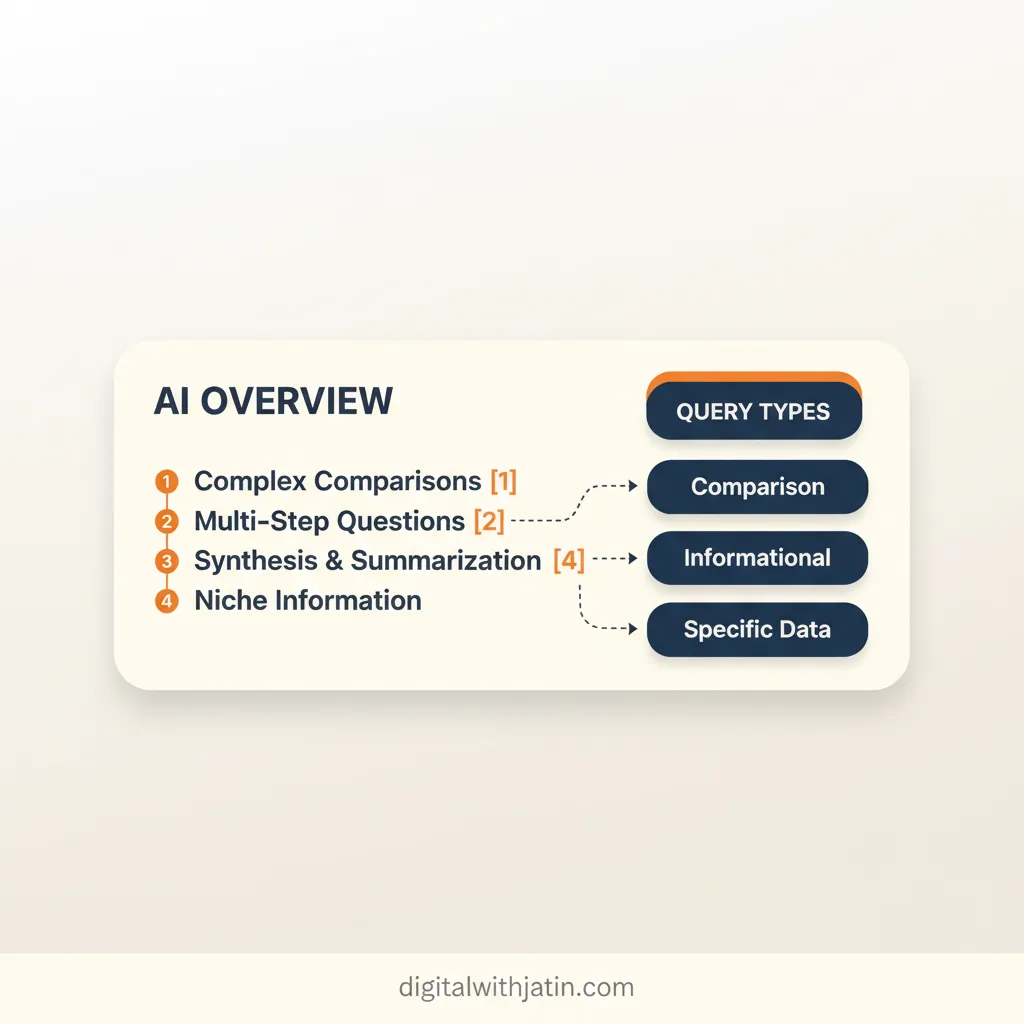
Informational queries, those starting with “what,” “how,” “why,” or “explain,” trigger AI Overviews most often. These are queries where a synthesized summary genuinely reduces user effort. A question like “what is aio in seo” is a strong candidate because it has a clear factual answer that can be stated in a short paragraph.
Commercial investigation queries show mixed behavior. Queries comparing products or services sometimes trigger an AI Overview with a neutral summary of options. Transactional queries, those with clear purchase intent, rarely trigger one because Google still routes those users to Shopping results, ads, and standard organic listings.
Local queries follow their own pattern. “Near me” and city-specific queries almost never produce an AI Overview. Instead, Google serves the local pack. This is relevant for site owners who split their content between informational and local pages.
Health, legal, and financial queries occupy a separate category Google internally treats with higher scrutiny. These YMYL (Your Money or Your Life) topics trigger AI Overviews less frequently, and when they do appear, the cited sources tend to be authoritative institutional domains.
Monitoring which of your target queries trigger AI Overviews is now a standard part of keyword research. Tools like Semrush, Ahrefs, and SE Ranking have added AIO detection filters to their keyword databases.
How to Earn an AIO Citation
Earning a citation in an AI Overview comes down to four concrete actions. None of them require a fundamentally different content strategy. They require more precision in how existing content is structured.
Step 1: Write a direct-answer block in the first 200 words. Place a single paragraph, 50-60 words, that answers the target query completely. This is the passage Google’s retrieval systems look for first. Think of it as a featured snippet answer embedded inside a longer post. The block should state the definition, the key fact, and the implication without referencing sections that come later in the page.
Step 2: Add FAQPage and Article schema. Structured data makes named entities and question-answer pairs machine-readable. FAQPage schema in JSON-LD format maps each question and answer so that Google’s systems can parse them without relying on layout inference. Article schema adds authorship and publication date, both of which contribute to the E-E-A-T signals that AIO selection favors. If you are also targeting Perplexity and ChatGPT search, a correctly formatted llms.txt file on the root domain can provide additional context to those retrieval systems.
Step 3: Cite primary sources for every numeric claim. AI Overviews are built to be accurate and defensible. Pages that cite primary research, official documentation, and first-party data are more likely to be selected as citations than pages that state facts without attribution. Every statistic on a page should link to its original source.
Step 4: Confirm crawler access. Check robots.txt to ensure Googlebot and Google-Extended are not blocked. Render the page without JavaScript disabled to confirm the direct-answer block appears in the raw HTML. Google’s retrieval works on the rendered DOM, but a server-side rendered answer block removes any uncertainty.
Pages that combine all four steps consistently outperform pages that address only one or two. Source authority built through topical depth across a content cluster matters more than domain size. A focused site with 20 thorough posts on a single topic can out-cite a large site with shallow coverage of many topics.
What AIO Citations Look Like in Practice
When an AI Overview appears in a SERP, it occupies a card above the first organic result. The card contains the AI-generated summary text and a set of inline citations displayed as small source chips or a collapsed panel. Clicking the panel expands a list of three to five URLs, each showing the page title, domain name, and a short excerpt from the cited passage.
The citation does not look like a traditional blue link. Users see the AI answer first, then the source panel. Some users expand the panel and visit the source. Others read the answer and move on. This is the behavior that affects CTR for position-one organic results.
| Feature | Classic SERP | AI Overview |
|---|---|---|
| Answer position | Position 1 organic | Above all organic results |
| Format | Title + meta description | AI-generated paragraph + source chips |
| Click behavior | Direct to page | Optional: expand sources, then click |
| Visibility signal | Impressions in GSC | AIO citation (no dedicated GSC filter yet) |
| Optimization target | Title tag, meta, H1 | Direct-answer passage, schema, source authority |
Google Search Console does not yet have a dedicated filter for AIO impressions. Tracking AIO citation frequency requires third-party tools or manual SERP checks against a keyword list.
Mistakes That Cost You AIO Citations
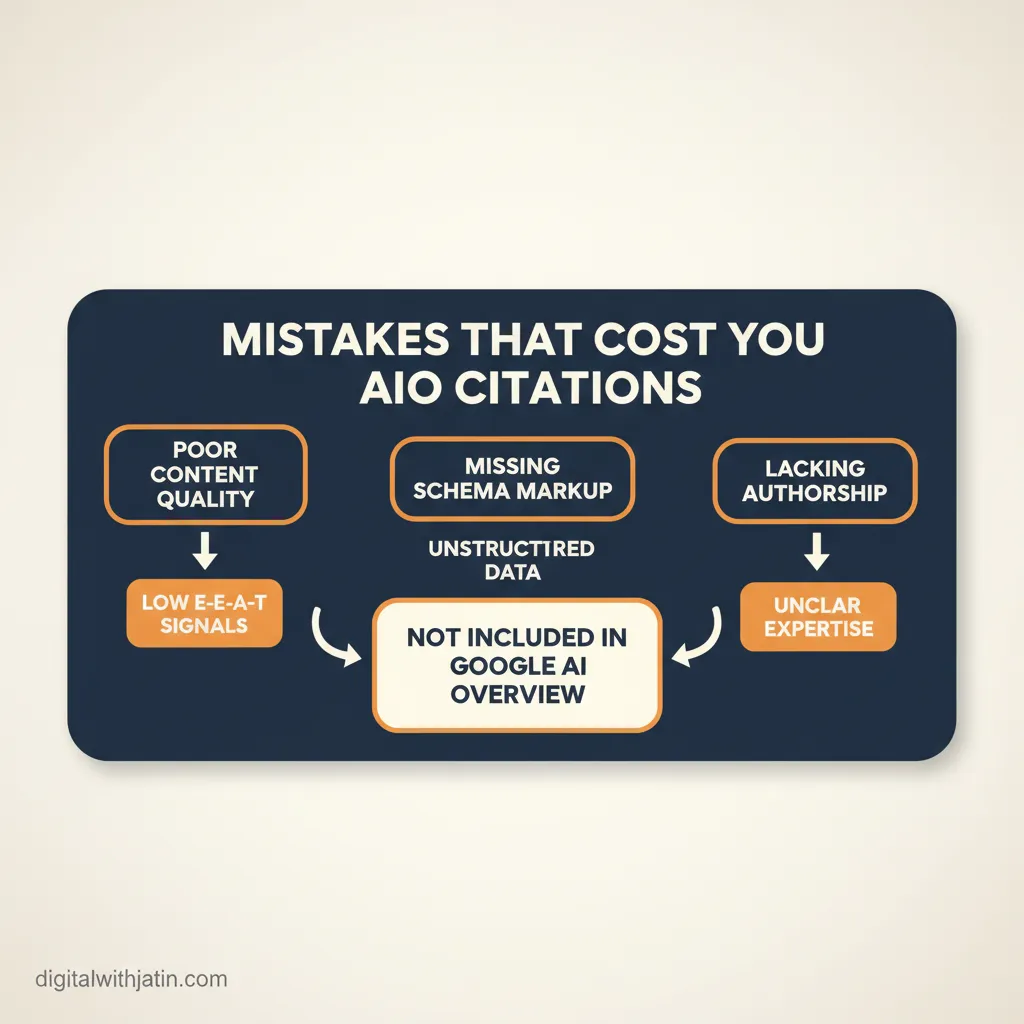
Several common patterns actively reduce the chance of citation, even on pages that rank well organically.
-
Burying the answer. Pages that open with background context, brand narrative, or multi-paragraph introductions before reaching the actual answer give Google’s retrieval systems nothing to extract from the first screen. If the direct answer is on scroll three, the page is unlikely to be cited even if it ranks in position one.
-
Blocking Google-Extended. Some site owners added
User-agent: Google-Extended / Disallow: /to robots.txt to prevent their content from being used in AI training data. This is a legitimate choice, but it has been associated with reduced AIO citation frequency. Site owners who want AIO visibility should allow Google-Extended. -
Missing or broken schema. FAQPage schema with malformed JSON, unclosed brackets, or mismatched question-answer pairs will fail validation and may not be parsed. Use Google’s Rich Results Test to confirm schema renders correctly before publishing.
-
Unattributed statistics. Pages that state figures without linking to a primary source introduce a trust gap. If Google cannot verify the claim through a crawlable source, the passage is less likely to be selected. Replace vague or unlinked statistics with inline citations to original research.
FAQ
What is AIO in SEO?
AIO stands for AI Overview, the AI-generated summary block Google shows above organic results for certain queries. It launched to all US users in May 2024 and draws content from Google’s standard crawl and index. The cited pages receive a brand mention and sometimes a click.
What does AIO stand for in SEO?
AIO stands for AI Overview. The abbreviation is informal but widely used in SEO communities. Google’s official name for the feature is “AI Overview,” introduced in May 2024 as the commercial launch of what was previously called Search Generative Experience (SGE).
How do I get my site into Google AI Overviews?
Place a 50-60 word direct-answer block in the first 200 words of each post, add FAQPage and Article JSON-LD schema, cite primary sources for every numeric claim, and ensure Googlebot and Google-Extended can crawl the page. Topical authority on the subject matters more than domain size.
Does appearing in an AI Overview hurt organic click-through rate?
Research from Search Engine Land and others suggests AIO citations can reduce CTR for position-one results, because users read the AI answer without clicking. The brand mention itself has measurable awareness value, and pages cited in AIO sometimes see referral traffic from users who want the full source.
The client from the opening of this post eventually recovered most of their lost traffic, not by reclaiming the position below the AI Overview, but by earning a citation inside it. The page was rewritten with a 55-word direct-answer block, FAQPage schema was added, and three unlinked statistics were replaced with primary source citations. Within six weeks, the site appeared in the source panel for the target query. Understanding what is aio in seo is only the start. Execution on the four steps above is what actually moves the needle. For help applying this to your own content, the AI SEO services page covers how that work gets done in practice.