A client sent me a screenshot last year: one of their AI-generated posts had climbed to position three on a commercial keyword, while a fully human-written post on the same topic was sitting at position eleven. Their question was the wrong one. They asked “is AI content better?” The right question is “what made that post rank?”
The answer had nothing to do with whether AI or a human wrote it. It had everything to do with whether the content satisfied the query.
Is AI content good for SEO?
Yes, when it is grounded in original input and reviewed by a human editor. AI-generated content is not good for SEO when it is prompt-and-published without editing, original observations, or fact-checked statistics. Google’s ranking systems evaluate helpfulness and expertise — not authorship method. The line between good and bad AI content for SEO is the editorial loop, not the drafting tool.
What Google actually said
The short version: Google does not care who or what wrote the content. It cares whether the content helps users.
Google Search Central’s February 2023 guidance was explicit: “Our focus on the quality of content, rather than how content is produced, is a useful guide that has helped us deliver reliable, high quality results to users for years.” That statement came after large-scale AI content had been indexed and ranked. It was not theoretical.
The helpful content guidelines reinforce this. The evaluation framework asks: does the content demonstrate first-hand expertise? Does it satisfy the query? Is it something a person would find genuinely useful? None of those questions mention provenance.
What does draw a penalty is thin, mass-produced content that exists to rank rather than to help. That was penalised before AI existed (think article spinners, scraper sites) and is penalised now regardless of the drafting method.

The four signals Google actually evaluates
The Google Quality Rater Guidelines define E-E-A-T: Experience, Expertise, Authoritativeness, Trustworthiness. These apply regardless of authoring method. What changes with AI drafting is which of the four you are at risk of weakening.
Experience. AI has no first-hand experience. It summarises what has been written. A post that describes testing a tool, running an experiment, or observing a pattern across client work has experience signals AI cannot fake. This is the piece a human editor must add.
Expertise. AI can organise established knowledge accurately. On technical topics with clear right answers (how Google renders JavaScript, what INP measures, how FAQPage schema works), AI drafts are often more accurate than rushed human ones. Expertise signal is not the problem.
Authoritativeness. A named byline with a verifiable track record — published on other platforms, cited by others, with consistent topical depth — is an authority signal AI cannot provide. It attaches to the author and the domain, not the draft.
Trustworthiness. Every numeric claim without a citation erodes trust. Every claim with a primary-source link builds it. AI drafts often include claims without sources. The editorial step must add them.
The formula that works: AI handles structure and first draft. A human adds the experience layer (what I actually saw, tested, or built), attaches named citations, and owns the byline. is ai content good or bad for seo then becomes a question of whether that loop happened, not of the tool used.
The google policy ai content teams keep misreading
Two misreadings show up constantly.
Misreading 1: “Google said AI content is fine, so we can publish without editing.” What Google said is that the quality bar applies to all content equally. The helpful content update ai teams need to internalise is that the quality bar is higher post-March 2024 core update, not lower. Unedited AI drafts typically fail on E-E-A-T signals, not on provenance.
Misreading 2: “Our competitor is publishing 30 AI posts a week and ranking. We should too.” Volume without quality compounds a site’s quality signal downward over time. Google’s systems evaluate the site as a whole alongside individual pages. A content velocity spike of thin posts hurts the strong pages too.
The editorial loop that makes ai generated content seo-safe
The loop I use on every post, including this one:
- Research before drafting. Pull the top SERP results, extract what each covers, identify the gap. This is what SERP research agents are for — scraping competitor headings and content summaries before the draft begins.
- AI drafts the structure and body. Sections, transitions, NLP term distribution, internal link anchors.
- Human adds the experience layer. A specific case, a real test result, a data point from client work that cannot be sourced from a search engine.
- Fact-check every statistic. Every number gets a primary-source URL. No naked stats.
- Named author with byline. Not “the editorial team.” A specific person with verifiable credentials.
- Schema attached. Article and FAQPage JSON-LD so the content is legible to both classic SERPs and AI search surfaces.
The result is content that is faster to produce than fully human-written, more consistent in structure and keyword distribution, and more authoritative because the human editing time is concentrated on the layer that matters.
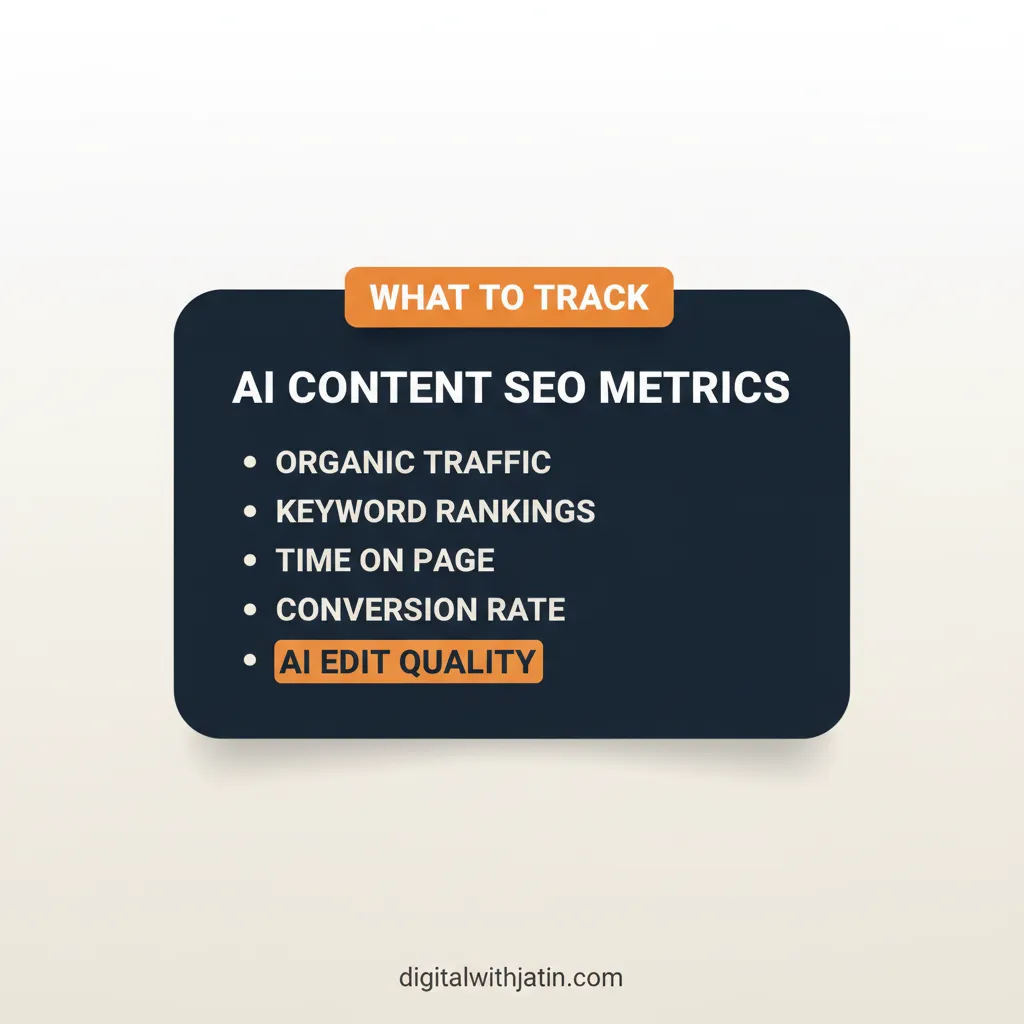
What to track
Most teams track whether AI content ranks. The better measurement:
- Does the post satisfy the query at the passage level? (Run it through ChatGPT and ask: “What is the most quotable passage from this page?” If the model paraphrases the whole post, the passages aren’t tight enough.)
- Does the post appear in AI Overviews, ChatGPT search, or Perplexity for the target query? (Use Profound, Otterly, or AthenaHQ.)
- Does the post’s E-E-A-T profile hold up if a quality rater looked at the author byline? (Check with a publication search for the author’s name.)
For the system view of how AI content fits into a broader SEO content operation, see the AI content SEO guide. For the on-page execution details, how to use AI for article SEO covers the workflow step by step.
If you want the editorial loop applied to your site with quality gates at each stage, that’s AI SEO consulting.