- Four automated SEO workflows: brief generation (keyword in, structured brief out, 5 minutes), schema generation (page content in, JSON-LD out, validated and ready to inject), daily publishing pipeline (cron-triggered post checks, publishes, and pings IndexNow), and citation monitoring (weekly Profound pull compared against rank data).
- Each workflow has a defined human review point. Automation replaces execution, not judgment. The brief still needs editorial approval before drafting begins.
- Anthropic's research on building effective agents identifies the principle that well-scoped agents with clear boundaries outperform general-purpose agents given broad instructions. Each of these four pipelines is tightly scoped.
- The highest-value automation for most SEO operations is the brief generation pipeline. It removes the most time-consuming step and produces a consistent output format that improves downstream content quality.
AI SEO automation gets described as either a revolution that replaces human SEOs or a distraction that produces low-quality output at scale. Neither description matches what actually works. The useful framing is narrower: specific workflows with defined inputs and outputs can be automated reliably. Workflows that require contextual judgment cannot. Understanding which is which determines whether automation makes you faster or just noisier.
This post covers four specific automated workflows. For each one: the input that triggers it, the tool handling the execution, the output produced, and the human review point where judgment is still required.
Why Scope Matters in SEO Automation
Anthropic’s research on building effective agents makes a point that applies directly to SEO automation: well-scoped agents with clear boundaries and defined task types outperform general-purpose agents given broad instructions. A Claude workflow told to “improve SEO” produces unreliable output. A Claude workflow told to “take this keyword, this list of the top five ranking URLs, and this brief template and produce a filled brief” produces consistent, usable output.
Every automation workflow described here is tightly scoped. Each one takes a defined input format and produces a defined output format. The human review point is where the scope ends and judgment begins.
For background on where AI agents fit into the broader AI SEO strategy, the posts on how to use AI agents in SEO and what AI simplifies in technical SEO work cover the conceptual layer. This post covers the practical pipeline detail.
Workflow 1: Brief Generation Pipeline
Input
A target keyword and a cluster context (which topic cluster this post belongs to, which internal links are available, and which competing posts on the site already exist to avoid duplication).
Tool
The workflow runs in n8n. The first step retrieves the top 10 ranking URLs for the keyword via the Ahrefs API keyword endpoint. The second step sends the URLs and the keyword to Claude with a structured system prompt that specifies the brief format: required subtopics in order of importance, target word count range, minimum FAQ count, internal link slots, schema type recommendation, and a one-sentence angle description. Claude processes the SERP data and outputs a formatted brief in the exact schema the editorial team uses.
Total running time: approximately 5 minutes from keyword input to brief output.
Output
A structured brief document in Markdown format covering: focus keyword, secondary keywords from the SERP analysis, target word count, required H2 and H3 sections with one-sentence descriptions, internal link placements with anchor text suggestions, external citation requirements, schema type recommendation, and the overall angle that differentiates this post from the ranking pages.
Human Review Point
The brief does not go to a writer until an editor has reviewed it. The review checks: does the angle actually differentiate from what ranks, are the required subtopics genuinely useful for the reader rather than just SERP-coverage-motivated, does the schema type match the content format, and are there any topic gaps the automated analysis missed because they require domain knowledge the SERP data does not surface? This review takes 10 to 15 minutes per brief. The automation removes the two to three hours of manual SERP analysis and brief writing that preceded it.
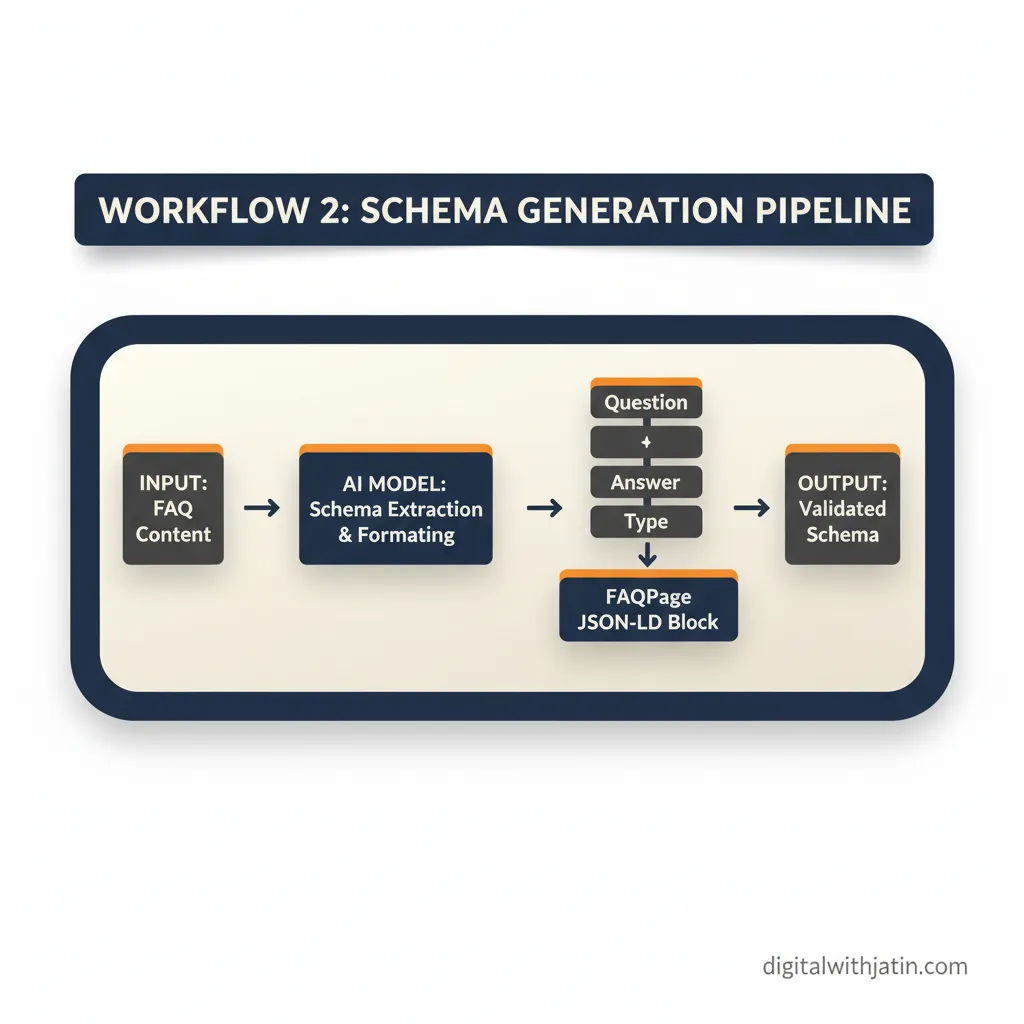
Workflow 2: Schema Generation Pipeline
Input
The published or near-final page content in plain text format, the page URL, the target schema type (FAQPage, Article, HowTo, or Product depending on the content type), and the site’s schema injection method (JSON-LD block in the page head).
Tool
Claude receives the page content and the target schema type via a direct API call (or through an n8n HTTP node connected to the Anthropic API). The prompt specifies the exact JSON-LD structure required, including the context declaration, the type, and the required properties for that schema type. Claude generates the schema block and includes placeholder values for any required properties not present in the content, flagged with a comment for the editor to complete.
The output schema is passed to a Google Rich Results Test API call (also in the n8n workflow) which validates the JSON-LD structure and returns a pass/fail plus any errors. If validation fails, the error is included in the output report for human review. If it passes, the schema is formatted for injection.
Output
A validated JSON-LD block ready to inject into the page head, plus a validation status report from the Rich Results Test. If validation failed, the output includes the specific error for an editor to resolve before injection.
Human Review Point
A developer or technical SEO reviews the validated schema before injection. The review checks: are the FAQ questions and answers accurate and complete (Claude generates these from content, but they may miss context), does the schema accurately represent the page (particularly for Article schema, where author and publisher information must be correct), and does the validation pass report match what appears in the Rich Results Test interface when checked manually on the final published URL?
Schema generation automation is particularly high-value for large sites with hundreds of pages that need schema added or updated. Running the pipeline against a full site content export and generating schema blocks in batch replaces weeks of manual schema writing with a few hours of human review.
Workflow 3: Daily Publishing Pipeline
Input
A scheduled posts queue: a list of posts in a content management system with a status field set to “scheduled” and a publish date field. The pipeline runs on a cron schedule (daily at a configured time, typically early morning in the target audience’s timezone).
Tool
The n8n workflow runs on schedule. Step one: query the CMS API for posts where status is “scheduled” and publish date matches today’s date. Step two: for each matched post, trigger the CMS publish action via the API (changing the status from “scheduled” to “published”). Step three: retrieve the published post URL and send an IndexNow ping to Bing’s indexing endpoint, which distributes the notification to connected search engines. Step four: call the Google Indexing API for eligible content types (if the site is eligible and has the API configured). Step five: log the publish event and ping status to a monitoring sheet.
Output
Published posts live on the correct date without manual intervention. An IndexNow ping sent within minutes of publication. A log entry confirming the publish action and ping status for each post in the day’s queue. An alert (via email or Slack webhook) if any post fails to publish or if the ping returns an error status.
Human Review Point
The human review for this pipeline is upstream: posts should be in “scheduled” status only after they have been through editorial review and QA. The automation only publishes posts that a human has already approved and scheduled. The daily log is reviewed each morning to confirm the pipeline ran correctly and to catch any failures. Posts that fail to publish get escalated immediately rather than silently missing their schedule.
IndexNow pings are not a replacement for organic crawl discovery, but they reduce the lag between publication and search engine awareness from days to hours in most cases. For sites publishing time-sensitive content or running topical authority campaigns where consistent daily publishing is part of the strategy, the reduction in indexing lag is meaningful.
Workflow 4: Citation Monitoring Pipeline
Input
A defined set of tracked queries (typically the primary focus keywords for the site’s most important pages, usually 50 to 200 queries depending on the operation size), pulled from a tracking sheet. The pipeline runs on a weekly cron schedule.
Tool
Step one: the n8n workflow calls the Profound API to retrieve citation share data for the tracked query set, covering Google AI Overviews, ChatGPT, and Perplexity responses. Step two: the same workflow calls the Ahrefs API to retrieve current organic rank data for the same query set. Step three: the workflow runs a comparison logic that identifies the three gap categories: queries where you rank organically but are not cited in any AI surface, queries where you are cited but rank below position five (suggesting authority growth is needed), and queries where a competitor is cited but you are not for the same query. Step four: the workflow generates a formatted report with the gap categories highlighted and sends it to the SEO team’s reporting channel.
Output
A weekly citation gap report with three sections: organic-rank-but-no-citation gaps (where schema, passage structure, or entity clarity work is likely needed), citation-without-strong-rank gaps (where authority and link building are the priority), and competitor-cited-but-not-you gaps (where content gap analysis should identify what the cited content has that yours does not).
Human Review Point
The SEO analyst reads the weekly report and assigns action items. The top organic-rank-but-no-citation gaps get scheduled for a schema and passage structure review within the current week. The competitor-cited-but-not-you gaps get added to the content audit queue with a note to check what schema type and passage structure the cited competitor is using. The report identifies the work. The analyst decides the priority order and assigns it.
Citation monitoring automation produces the most strategic value when the report is acted on consistently rather than reviewed and filed. The weekly cadence works because AI Overview citation share changes slowly enough that daily monitoring produces noise, but fast enough that monthly monitoring misses opportunities to respond to shifts before they compound.
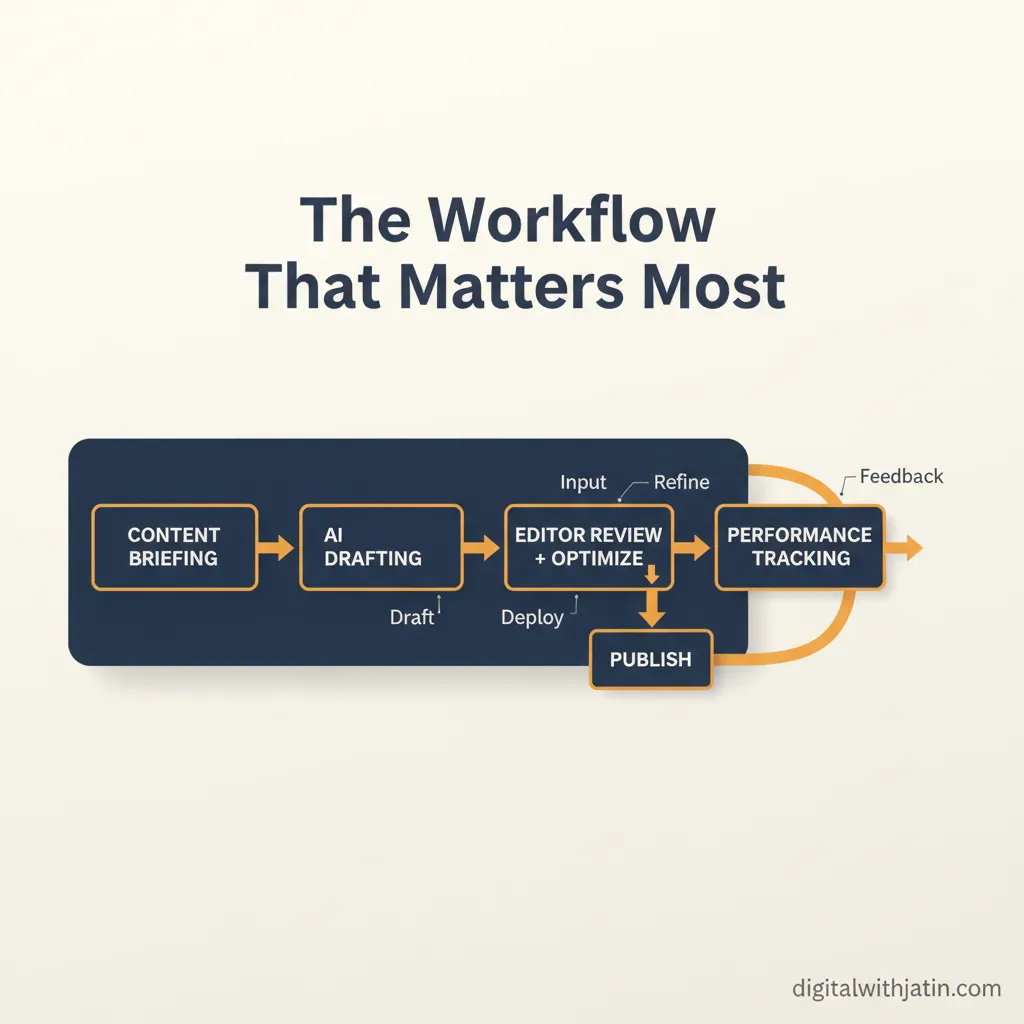
The Workflow That Matters Most
If you are starting from zero on AI SEO automation, the brief generation pipeline is where to begin. It produces the clearest time saving (several hours per brief reduced to 15 minutes of human review), it improves downstream content quality by standardising the brief format, and it is the step that most directly determines whether content ranks and gets cited.
Schema automation is the second priority. Most sites have large content archives with missing or incomplete schema. A batch schema generation run against an existing content export, validated, and reviewed by a developer is a one-time effort with ongoing citation benefit.
The publishing pipeline and citation monitoring come third and fourth in priority. They add operational reliability (consistent scheduling, no missed publish dates) and strategic signal (weekly citation gap data that informs editorial decisions). But neither produces value unless the content being published is already well-briefed, well-written, and properly schema-marked.
The general principle behind all four pipelines is the same: automate the repeatable execution step, preserve the judgment step for a human. That boundary is the difference between automation that improves an SEO operation and automation that just makes it faster to produce content that does not work.
For a look at how these pipelines fit into the full AI SEO strategy across research, content, technical, and citation tracking, the post on what is an AI SEO strategy covers the four-component framework. For the tool decisions behind each pipeline, the post on best AI tools for SEO covers specific tool verdicts across all categories.
What is AI SEO automation?
AI SEO automation uses AI models and workflow tools to handle specific, repeatable SEO tasks without manual execution per instance. The four main pipeline types are brief generation, schema generation, scheduled publishing with index pings, and citation monitoring. Each pipeline has a defined input, a defined output, and a human review point where judgment determines whether the automated output is acted on.
What SEO tasks can be automated with AI?
Tasks with consistent inputs and defined output formats automate well. Brief generation from keyword and SERP data, schema JSON-LD generation from page content, meta description drafting, FAQ generation, internal link mapping, scheduled publishing with IndexNow pings, and weekly citation share pulls are all reliable automation targets. Strategic prioritisation, editorial direction, and client communication require contextual judgment and do not automate reliably.
How does the brief generation pipeline work?
The pipeline takes a keyword input, retrieves the top-ranking URLs via the Ahrefs API, passes that data to Claude with a structured brief template prompt, and outputs a formatted brief covering angle, subtopics, word count, internal link slots, and schema type. Total processing time is approximately five minutes. A human editor reviews the brief before it goes to a writer. The automation removes the manual SERP analysis and brief writing, not the editorial judgment step.
What is IndexNow and why is it used in SEO automation?
IndexNow is a protocol that notifies search engines directly when content is published or updated. In an automated publishing pipeline, an IndexNow ping fires within minutes of a scheduled post going live. This reduces the lag between publication and search engine awareness from days to hours. Bing shares IndexNow notifications with other connected engines. Google’s Indexing API serves a similar function for Google specifically, for eligible content types.
How does citation monitoring automation work?
A weekly cron job calls the Profound API for citation share data across Google AI Overviews, ChatGPT, and Perplexity for a tracked query set. A parallel call retrieves organic rank data from Ahrefs or GSC. The workflow compares the two datasets and generates a gap report identifying: queries where you rank but are not cited, queries where competitors are cited but you are not, and queries where you are cited but rank below position five. A human analyst reads the report and assigns action items.
What tools are needed for AI SEO automation?
The core tools are Claude or GPT for text generation tasks (brief writing, schema generation, meta descriptions), n8n or Make for workflow orchestration between services, the Ahrefs API for keyword and rank data, Profound for citation monitoring, IndexNow for post-publish pings, and the Google Search Console API for organic performance data pulls. The specific combination scales with which workflows are being automated and the volume of content being managed.
How long does it take to set up AI SEO automation?
The brief generation pipeline takes approximately one to two days to set up if you have Ahrefs API access and an n8n instance running. Schema generation is similar. The publishing pipeline with IndexNow integration takes two to three days for initial setup and testing, longer if CMS API access needs configuration. Citation monitoring via Profound depends on Profound API access and the number of tracked queries. Start with the brief generation pipeline first and add workflows progressively rather than setting up all four simultaneously.
The value of automation in SEO is not in removing humans from the process. It is in removing humans from the parts of the process that do not need them, so that human time concentrates on the decisions that actually require judgment. A brief generation pipeline frees an analyst from three hours of SERP analysis and brief writing per post. That time is better used reviewing the brief, shaping the editorial direction, and making the strategy decisions that determine which keywords to target in the first place.
The four workflows here are the concrete implementation of that principle: each one is scoped tightly, produces a defined output, and has a named human review point. The automation makes the execution consistent. The human review makes it accurate and strategically aligned.
If you want help building any of these pipelines for your own SEO operation, the AI SEO services page covers what a full build-out looks like in practice.