- Three things are already settled: AI Overviews are a permanent part of Google search, citation share is a real and measurable metric, and topical depth now matters more than publishing volume.
- Three things are genuinely uncertain: how much classic blue-link traffic will shift to zero-click AI answers, whether Google will extend AI Overviews to commercial queries, and how Perplexity and ChatGPT will affect Google's market share over time.
- Google announced AI Overviews at Google I/O May 2024, making clear the product is a core part of Search rather than an experiment.
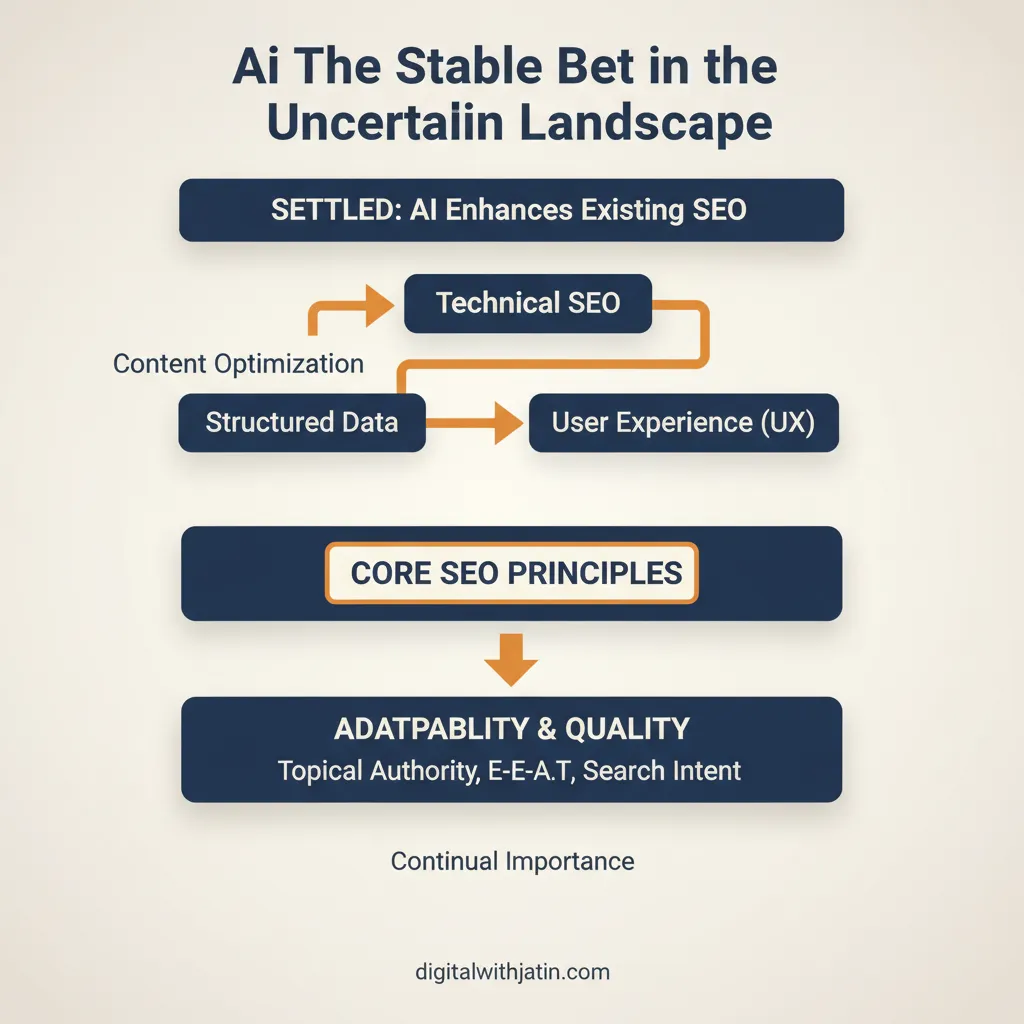
- The only stable response to this uncertainty is to build content that earns both organic rank and AI citation. The overlap between those two goals is where the durable SEO strategy lives.
When Google announced AI Overviews at Google I/O in May 2024, the SEO industry produced two types of responses: confident predictions about exactly what would happen to traffic and search behaviour, and equally confident counter-predictions. Two years later, some things have settled and others remain genuinely open. The most useful thing you can read about AI and the future of SEO right now is an honest separation of those two categories.
I’m Jatin Lokwani, an AI SEO specialist based in Ahmedabad. I have tracked citation share and organic rank across client sites in India, AU, and US markets since AI Overviews launched in mid-2024, giving me a continuous observation window across the full period of the product’s expansion. One D2C brand I work with moved from zero AI Overview citations to appearing in 14 target queries within 90 days (tracked weekly through Profound against a 22-query target set) by restructuring content around passage-level clarity, without changing its organic rank strategy. Across the sites I track, pages ranking in positions 1–3 organically are cited in AI Overviews at a consistently higher rate than pages in positions 4–10 for the same queries, but the relationship is not automatic. Some position-one pages are never cited. Some position-six pages are cited consistently. That gap is what makes citation share a distinct metric worth tracking.
Direct answer: AI and the future of SEO divides into settled and uncertain. Settled: AI Overviews are permanent, citation share is a measurable new metric, and topical depth beats volume. Uncertain: zero-click traffic share, AI Overview expansion to commercial queries, and Google’s long-run market split vs. Perplexity and ChatGPT. The stable strategy is content that earns both organic rank and AI citation.
| Already Settled | Still Genuinely Uncertain |
|---|---|
| AI Overviews are a permanent Google product | How much informational traffic shifts to zero-click permanently |
| Citation share is a measurable new SEO metric | Whether Google extends AI Overviews to commercial queries |
| Topical depth outperforms publishing volume | How Google’s market share evolves vs. Perplexity and ChatGPT |
What Is Already Settled About AI and the Future of SEO
AI Overviews Are a Permanent Part of Google Search
Google’s May 2024 announcement made clear that AI Overviews are a core product, not a test. The feature was described as rolling out to over a billion users by end of 2024, and subsequent Search status updates confirmed continued expansion by query type and geography.
This matters for strategy because it ends the “wait and see” question. Some SEOs argued that AI Overviews might be rolled back if user satisfaction metrics were poor. The product has continued to expand, not contract. Planning your content strategy around a Google SERP that does not include AI Overviews is planning for a past that is not coming back.
The practical implications were covered in detail in the post on how SEO will change with AI, but the short version is: for informational queries where AI Overviews appear, the zero-position result is now frequently an AI-generated summary rather than a featured snippet from a ranked page. Ranking in position one still matters, but what happens at position zero has changed.
Citation Share Is a Real and Measurable Metric
Before 2024, SEO performance was measured primarily through organic rank, impressions, and traffic. None of these metrics captures whether your brand is being cited in AI-generated answers that appear before the first organic result.
Citation share fills that gap. It tracks which sources appear in AI Overview, ChatGPT, and Perplexity responses for a defined set of target queries. Tools like Profound now allow consistent citation tracking across surfaces, making it possible to monitor AI visibility with the same discipline applied to organic rank tracking.
Citation share is not a vanity metric. In the campaigns I track through Profound, pages in the top 3 organic positions account for a disproportionate share of AI Overview citations, which means organic rank and citation share are correlated, but a page can rank well without being cited and be cited without ranking on page one. A brand cited in AI Overviews for a high-volume informational query gets brand exposure to users who never click through to the organic results. For branded and semi-branded queries, AI citation shapes perception before any click happens. For informational queries in competitive niches, being excluded from AI citations while competitors are included is a measurable visibility deficit.
Topical Depth Matters More Than Publishing Volume
The shift from volume-based to depth-based content strategy has been underway since Google’s helpful content updates of 2022 and 2023, but AI search has accelerated it. AI Overviews draw from pages that rank well organically, and ranking well on a topic now depends more on the depth and coherence of a site’s coverage than on the number of posts published.
A site with 20 well-structured, specific, expert-level posts on a topic cluster outperforms a site with 200 thin posts on the same topic. Semrush’s analysis of AI-driven queries confirms this was already true before AI Overviews, and the citation selection process for AI-generated answers makes it more pronounced now, filtering toward authoritative, complete sources over thin coverage.
For SEO planning, this means publishing pace is the wrong primary metric. When thinking about AI and the future of SEO, content coverage completeness (do you have a clear, specific answer to every meaningful question within your topic cluster?) and topical authority (is your domain associated with this subject area through ranking history and inbound link patterns?) are the metrics that predict AI citation performance.
For a worked example of how to build this kind of topical depth, the post on what is an AI SEO strategy covers the four-component framework in detail.
What Remains Genuinely Uncertain About AI and the Future of SEO
How Much Blue-Link Traffic Will Permanently Shift to Zero-Click
The research on zero-click search has a long and contested history. Studies from SparkToro and Rand Fishkin have tracked zero-click rates over multiple years, with different methodologies producing different estimates. The introduction of AI Overviews adds a new layer to this already-complex picture.
The honest answer is that the long-run steady state for informational query traffic is unknown. Some informational queries have already moved toward very low click-through rates because the AI Overview answers the question well enough to satisfy the user without a visit. Others have not changed materially. The pattern is not uniform across query types, and the data available so far covers a period of rapid product change rather than a stable equilibrium.
What this means for strategy is that you cannot confidently predict what percentage of informational traffic will be available to organic results in two or three years. You can observe the current pattern, track it, and adjust. You cannot model it forward with confidence.
Whether Google Will Extend AI Overviews to Commercial Queries
As of this writing, AI Overviews appear most consistently on informational queries: how-to questions, definition queries, comparison queries at the research stage of a purchase. They appear much less frequently on transactional and commercial queries, where Google’s business model depends on advertisers paying for clicks.
The question of whether Google will extend AI Overviews to commercial intent queries has very significant implications for e-commerce SEO. If a user searching “best running shoes under $100” gets an AI-generated list of recommendations rather than a set of organic results and ads, the traffic and revenue dynamics for e-commerce brands and affiliate publishers change substantially.
Google has financial incentives on both sides. AI Overviews on commercial queries would accelerate the shift toward AI search adoption but would cannibalize paid click revenue. The resolution of that tension is not visible from the outside. Watch the product, not the predictions.
How Perplexity and ChatGPT’s Market Share Evolves Relative to Google
Google handles roughly 90% of global search queries according to StatCounter’s search engine market share data. Perplexity and ChatGPT with web search handle a much smaller share, concentrated in certain demographics and use cases. The question is whether that distribution shifts significantly over a two to five year horizon.
There are real arguments on both sides. Perplexity and ChatGPT offer a genuinely different search experience: conversational, multi-step, source-citing. A share of users who have shifted to these tools for research-oriented queries have not moved back.
At the same time, Google’s distribution advantages (default search on Android, Safari deal, Chrome integration) are structural, not just preferential, and are difficult to overcome at scale.
The uncertainty matters for SEO strategy because the tools required to rank in Google and to be cited in Perplexity overlap significantly but are not identical. Bing’s index underpins ChatGPT web search, which means Bing Webmaster Tools and Bing’s indexing API are part of multi-surface visibility in a way they were not relevant three years ago.
For a full breakdown of how to optimise for multiple AI surfaces simultaneously, the post on how to merge SEO and AEO for AI visibility covers the technical approach.
The Stable Bet: AI and the Future of SEO Strategy That Holds
Given genuine uncertainty in three areas, what is the content and SEO strategy that remains useful across the widest range of outcomes? Practitioners asking about AI and the future of SEO need an answer that holds across multiple possible outcomes, not just the most likely one.
The answer is not complicated, even if the execution is: build content that earns both organic rank and AI citation. These two goals have substantial overlap.
What the Overlap Looks Like in Practice
The requirements for AI and the future of SEO converge more than they diverge:
- Topical authority: needed for organic rank; also the primary predictor of AI citation selection
- Passage-level answer clarity: needed for AI Overviews to extract a citation; also correlated with featured snippet capture
- Schema markup: needed for rich results; also increases the probability of AI surface recognition
- Domain authority: needed for organic ranking; AI surfaces disproportionately cite organically authoritative sources
A concrete example: a section written as a direct answer to a sub-question, structured with a clear H2 or H3 and wrapped in FAQ schema, satisfies both the organic rank signal (structured, relevant content) and the AI citation signal (an extractable passage that answers a specific query). You do not write two versions of the post. You write one version that does both jobs. This is, in practice, what AI and the future of SEO preparation looks like at the content level.
A piece of content that achieves both has to be specific, accurate, well-structured, and part of a coherent topical cluster. That description applies whether the search interface is ten blue links, an AI Overview, or a Perplexity response.
Content that only optimises for organic rank (keyword density, internal links, length) and ignores passage clarity and schema will increasingly underperform on AI surfaces.
Content that only optimises for AI citation without the underlying domain authority and technical health to support organic ranking will be cited less, because AI surfaces draw from organically authoritative sources.
The overlap between organic rank requirements and AI citation requirements is where the stable strategy lives. Not because it avoids the uncertainty, but because it is the correct response to a range of outcomes: if AI Overviews expand, you are cited in them; if organic traffic holds, you rank for it; if commercial queries remain outside AI Overviews, your transactional pages are in position.
Where to Go from Here
For anyone working through what AI and the future of SEO means for their site specifically, the audit starts in one place. The most useful practical step is to measure where you currently sit across both dimensions: organic rank for your target queries and AI citation share for the same queries. The gap between the two tells you which component of the framework needs work.
If you rank organically but are not cited in AI Overviews, the issue is usually passage structure, schema, or entity clarity. If you are cited in AI Overviews but do not rank organically, the authority and crawl health layer needs attention.
The post on how to do AI SEO covers the step-by-step process for both dimensions. The post on will SEO be replaced by AI addresses the longer-run question for anyone who needs to think through AI and the future of SEO from the ground up before acting.
The future of SEO is not a single defined state. It is a series of changes, some of which have already settled and some of which are still in motion. The strategy that holds up is one built on both the settled certainties and a flexible response to the open questions. That is what AI and the future of SEO comes down to: not prediction, but preparation across both layers.
Frequently Asked Questions
How is AI changing the future of SEO?
AI and the future of SEO is changing at two levels simultaneously. The search interface level: AI Overviews now appear on a large share of informational queries, meaning some traffic that previously went to ranked pages stays inside the Google results page. The tools level: AI is used inside SEO workflows for research, brief generation, content drafting, schema markup, and reporting. Both changes are permanent, and both require updated strategy.
Will SEO still exist with AI?
Yes. The need to be visible to people searching for information, products, and services persists regardless of the interface. What changes is how visibility is measured and where traffic goes. Citation share in AI answer surfaces is the new metric alongside organic rank. SEO as a discipline continues, but the scope broadens to cover multiple surfaces rather than only Google’s ten blue links.
What is citation share and why does it matter?
Citation share is the proportion of relevant AI-generated search answers in which your brand, content, or domain is cited or referenced. For anyone thinking through AI and the future of SEO in practical terms, this is the metric that makes the change concrete: it is measured using tools like Profound across Google AI Overviews, ChatGPT, and Perplexity responses. A brand cited in AI Overviews for high-volume queries gets meaningful visibility to users who never click through to organic results, independent of whether they ever see an organic result at all.
The questions about AI and the future of SEO that deserve confident answers should get them. AI Overviews are permanent. Citation share is measurable and matters. Topical depth beats volume. The questions that are genuinely open deserve the honest answer that they are open: zero-click rates on informational queries, commercial query expansion, and the long-run Google versus AI-native search split are all real uncertainties.
The stable response is to build content that serves both goals: rank and citation. If you want to build that system, the AI SEO services page covers how it is structured in practice.