Last quarter I ran keyword research for a Shopify skincare brand from scratch. The brief was thin: one product category, one target audience, no existing content. Using Claude and Ahrefs together, I had 84 validated keyword clusters mapped to search intent in 40 minutes. The same task done manually had taken me a full day on a previous brand.
I’m Jatin Lokwani, an AI SEO specialist based in Ahmedabad. As of May 2026, I use this workflow across client projects in India, AU, and US markets. This post explains how to use AI to conduct keyword research for SEO the same way.
How to use AI to conduct keyword research for SEO
Direct answer: Use AI to generate and expand a seed keyword list, then cluster those terms by search intent using a prompt, then validate every term against Ahrefs or Semrush volume and keyword difficulty data before building your content calendar. AI handles ideation at scale; keyword tools handle validation. Neither replaces the other.
The 5-step process: seed, expand, cluster, validate, prioritize. Each step has a specific tool, a specific output, and a handoff condition that tells you when to move to the next step.
What AI does well in keyword research (and what it doesn’t)
AI is fast at generating keyword variations a human would miss. Feed it a topic and a target audience and it returns 40 to 60 terms in seconds.
This includes question-format variants that show up in PAA boxes, semantic clustering alternatives, and comparison-format terms (“X vs Y”) that autocomplete tools rarely surface.
| What AI does well | What AI gets wrong |
|---|---|
| Seed expansion: 30 to 50 variants from one seed term across modifiers, intents, and word orders. What took 2 hours manually now takes 3 minutes. | Search volume: AI has no live database. It cannot tell you whether a term gets 50 or 5,000 monthly searches. Every AI-generated list must be validated against a real keyword tool. |
| Semantic clustering: groups a flat keyword list by topic and query intent faster than any spreadsheet formula. Imperfect groupings, but better than alphabetical sorting. | Keyword difficulty and SERP competition: AI cannot read a SERP. It does not know whether the top three results are DR 90 domains with 400 backlinks. Ahrefs and Semrush give you that number. |
| Question-format and NLP keyword generation: surfaces “how”, “what”, “which”, “can”, “should” variants for FAQ schema and PAA box targeting. Often the easiest terms to rank for and the hardest to find with autocomplete. | Predicting ranking timelines: AI can guess, but guesses based on stale training data are not useful for planning. Use tool data for any decision involving publishing priority or resource allocation. |
Semrush’s analysis of AI-driven queries confirms that search behavior is shifting toward longer, more conversational queries, which is exactly the type AI excels at generating. The validation step keeps that list grounded in actual search demand.
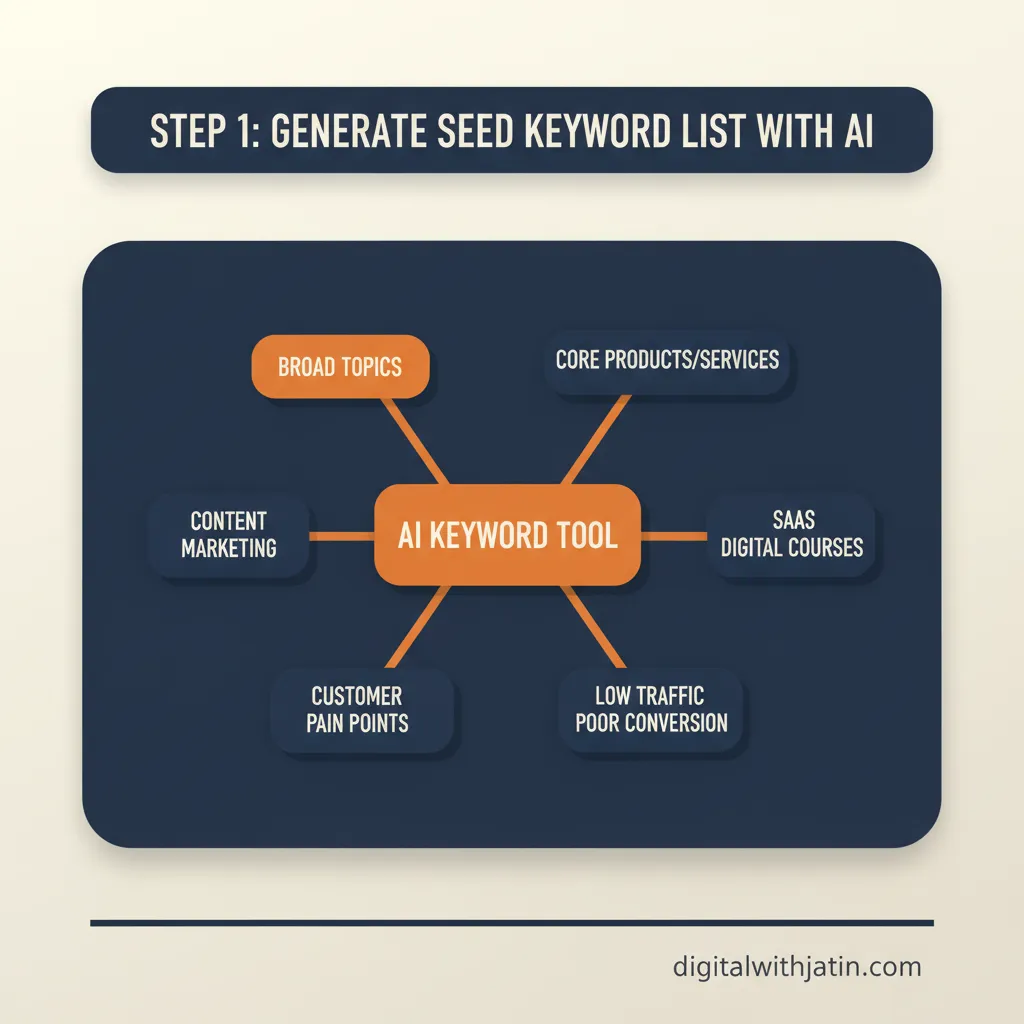
Step 1: Generate a seed keyword list with AI
Start with a prompt that gives the AI three things: the topic, the target audience, and the search intent mix you want. Do not ask for “keyword ideas.” Ask for a structured list with intent labels.
Here is the prompt template I use for every new keyword project:
You are an SEO strategist. Generate a keyword list for the following:

Topic: [insert topic or product category]
Target audience: [insert audience description]
Funnel stage mix: 40% informational, 40% commercial, 20% transactional

Output format:
- Keyword | Intent | Funnel stage
- Include 30 to 50 unique terms
- Include question-format variants (how, what, why, which, can)
- Include long-tail variants of 4 or more words
- Do not include brand names
- Do not pad the list with near-duplicate phrases
Run this once in Claude and once in ChatGPT. The two models surface different angles. The combined output, before any deduplication, is your raw seed list. Treat it as raw material only. No term goes into your content brief until it has been validated in step 4.
The goal of this step is topical depth, not precision. You want 80 to 100 raw terms that cover the full semantic surface of the topic. You will cut 60% of them in validation.
Step 2: Expand with semantic and question-format variants
Take the top 15 to 20 terms from the seed list and run them through a second prompt focused on expansion. This is where you surface the PAA box terms and the long-tail secondary keywords that have lower keyword difficulty and faster ranking potential.
Use this prompt template for expansion:
You are an SEO strategist specializing in question-format and long-tail keywords.

Given the following primary keywords:
[paste 15 to 20 terms from step 1]

Generate:
1. Question variants for each term (what, how, why, which, can, should, is)
2. Comparison variants (X vs Y, X or Y, X alternative)
3. Long-tail extensions of 4 or more words with a modifier (best, free, for beginners, for [specific audience], without [tool/cost])
4. NLP keyword variants that describe the same concept with different phrasing

Output as a flat list with intent label next to each term.
The output from this step fills in the gaps that autocomplete misses. A keyword tool shows you what people are searching. This prompt shows you what they are searching but phrasing differently, which often reveals terms with real volume and lower competition.
Keep a separate column for these expansion terms. They are candidates for secondary keywords, internal link anchor text, and FAQ schema questions, not necessarily primary keywords for standalone posts.
Step 3: Cluster by search intent
At this point you have 100 to 150 raw terms. The next step is grouping them into clusters that map to a single piece of content. Do not build one post per keyword. Build one post per intent cluster.
Use this prompt to cluster the full list:
You are an SEO content strategist. Group the following keyword list into clusters. Each cluster should:
- Share the same primary search intent (informational, commercial, navigational, transactional)
- Target the same query intent (what-is, how-to, comparison, list, review)
- Be addressable by a single piece of content without content cannibalization

For each cluster, name the cluster and list the primary keyword plus all secondary keywords.

Keyword list:
[paste full list from steps 1 and 2]
The output will look like a content calendar skeleton. Each cluster becomes one post, one landing page, or one FAQ section. The primary keyword in each cluster is the one you target in the title and H1. The secondary keywords are the ones you target in H2s and throughout the body.
This step eliminates content cannibalization before you publish anything. If two clusters cover the same query intent with different phrasing, merge them. One strong post beats two weak ones targeting overlapping terms. The cluster structure also builds topical authority in AI SEO, which affects both classic rankings and AI Overview citation eligibility.
Step 4: Validate with a keyword tool
This is the non-negotiable step. Every term from the AI-generated clusters goes into Ahrefs or Semrush for validation before anything is scheduled.
The validation workflow:
- Export the clustered keyword list to a spreadsheet, one keyword per row.
- Run the list through Ahrefs Keywords Explorer or Semrush Keyword Magic Tool in batch mode.
- Pull three columns: monthly search volume, keyword difficulty (KD), and SERP features (featured snippet, PAA, AI Overview).
- Filter: keep terms with 50 or more monthly searches and KD below your site’s current authority threshold.
- Flag any term with zero volume and remove it from the calendar. AI generates plausible-sounding terms that nobody searches. Validation catches them before you waste a post.
For new sites with low domain rating, target KD under 20 for the first three months. For established sites, you can target up to KD 40 on terms where the SERP shows a mix of domain authorities.
Google’s helpful content guidelines are explicit that content should be written for people, not for search engines. Validation against real volume data keeps you focused on terms that actual people are searching, rather than AI-generated variations that look semantically logical but have no real demand.
Also check the SERP features column. Terms with a featured snippet or PAA box are direct-answer block opportunities. Terms with an AI Overview in the SERP require a different content approach, specifically, structured, citable content that follows E-E-A-T signals rather than thin opinion pieces.
Step 5: Prioritize the final list
After validation, you have a clean cluster list with volume and KD data. The last step is building a publish sequence based on opportunity, not on what feels most interesting to write.
The opportunity score formula:
Opportunity score = Volume x (1 / KD) x Intent match score

Intent match score:
- Transactional (service/product page) = 3
- Commercial (comparison, review) = 2
- Informational (how-to, what-is) = 1
Set this up in a spreadsheet with three columns: Volume, KD, Intent match. One formula per row. Sort descending by opportunity score. That sorted list is your content calendar sequence.
High volume, low KD, and strong commercial or transactional intent should publish first. Informational clusters with high topical authority value publish next, because they build the semantic context around your commercial pages. Publish in priority order, not in the order you researched the keywords.
One practical note: do not publish more than two posts per cluster topic per month. Space out topically related content so each post has time to index and build its own authority signal before you add the next related post.
FAQ
Can ChatGPT do keyword research by itself?
ChatGPT can generate keyword ideas and cluster them by intent, but it cannot pull live search volume or keyword difficulty data. Use it for ideation and clustering, then validate with Ahrefs, Semrush, or Google Search Console before building your content calendar.
How is AI keyword research different from traditional keyword research?
Traditional keyword research starts with a tool (Ahrefs, Semrush) and manual SERP review. AI keyword research starts with prompt-driven ideation, then uses tools to validate. AI surfaces angles and question variants that autocomplete misses; tools confirm what actually has search demand.
Which AI tool is best for keyword research?
ChatGPT (GPT-4o) and Claude Sonnet handle keyword expansion and clustering well. For volume and difficulty, Ahrefs Site Explorer or Semrush Keyword Magic Tool are the validation layer. No AI tool replaces a keyword database yet.
The Shopify skincare brand I mentioned at the start published 14 posts from that 40-minute keyword session. Eleven of them ranked in the top 20 within 60 days. That is not because the AI keywords were magic. It is because the validation step cut out every term without real demand, and the priority scoring ensured the highest-opportunity posts went live first. That is how to use AI to conduct keyword research for SEO without losing the discipline that makes rankings hold. If you want this workflow applied to your site’s content calendar with a full cluster map and priority score, the AI SEO service covers both research and implementation.