- AI compresses link building research and drafting. It does not replace relationship-building or journalist contacts.
- Best use cases: filtering backlink lists by relevance, drafting personalised outreach, identifying linkable asset gaps.
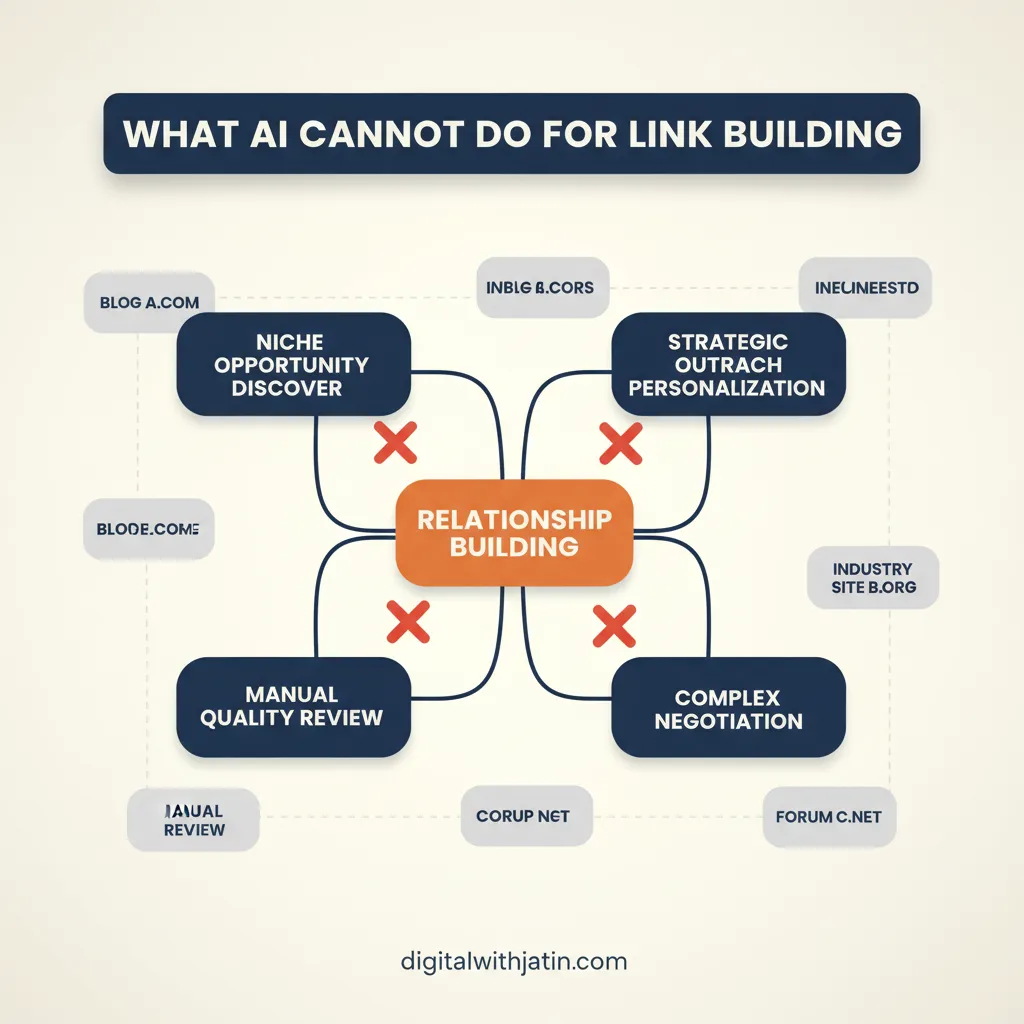
- The tasks AI cannot automate: editorial relationship building, digital PR, predicting which links will move rankings.
- Workflow: export competitor backlinks → filter with AI → draft outreach → human sends and follows up.
Running link building outreach for a client last quarter, the target-filtering step used to take half a day. Open Ahrefs, pull competitor backlinks, sort by domain rating, manually read each linking page, decide if it was relevant. For a list of 500 prospects, that was four to five hours of slow, repetitive reading.
With an LLM filter applied to the exported CSV, the same step ran in four minutes. Same quality output, fraction of the time.
I’m Jatin Lokwani, an AI SEO specialist based in Ahmedabad. Learning how to use AI for link building is what this post covers: which steps it compresses, and which ones it cannot touch. As of May 2026, I run this four-step workflow across every client campaign.
How to use AI for link building
Direct answer: AI handles the research and drafting stages of link building: filtering large backlink lists by relevance, identifying what content types earn links in your niche, drafting personalised outreach emails from target page content, and sequencing follow-up messages. It does not replace the relationship-building, editorial judgment, or journalist trust that produces the links that actually move rankings.
What AI handles well in link building
There are four specific stages where AI compresses real time. This is how to use AI for link building in practice: not as a replacement for outreach, but as a triage and drafting layer.
Target identification. Export a competitor backlink profile from Ahrefs or Semrush, feed it to Claude Sonnet or GPT-4o with a filtering prompt, and the model returns a ranked shortlist in under a minute. What took manual reading now runs as part of a pipeline.
Outreach email drafting. AI reads a target page URL and generates a personalised first-draft pitch that references something specific from the target content. In my own workflow, a human produces around 3 personalised drafts per hour; with AI, that same hour produces 30. Human review remains mandatory before anything sends.
Linkable asset gap analysis. The model scans the filtered target list, identifies the content types those pages link to (original data, free tools, comparison guides), and cross-references your existing content. The gap is your content priority list.
Follow-up sequence drafting. Two short follow-up emails, written once, reviewed once. AI writes the draft; the human sends from their own inbox.
What AI cannot do for link building
The question of how to use AI for link building has a clear boundary. AI compresses the mechanical stages, but the category of link building that produces the highest-authority placements is almost entirely outside what any current LLM can do.
Editorial relationships are built through years of publishing credible content, attending industry events, and being the person journalists already know when a story comes up. An AI agent cannot make that call. It cannot have the coffee meeting. It cannot build the reputation that makes an editor answer a cold email from a name they recognise.
Digital PR operates on journalist contacts, press databases, and timing. A pitch sent at the wrong moment to the wrong person is ignored regardless of quality. AI has no visibility into a journalist’s beat history, deadline schedule, or current story list. Tools like Pitchbox layer AI on top of prospecting workflows, but the relationship context still comes from the human.
Retrieval-augmented generation can help an AI read and synthesise information about a contact, but it cannot manufacture trust. And no LLM can tell you which specific links will move your rankings. The correlation between link attributes and ranking impact involves too many confounding variables. AI that claims to predict this is guessing.
Step 1: Filter competitor backlinks with AI
Pull the backlink profiles of your top three ranking competitors for your target keyword. Export as CSV from Ahrefs or Semrush. You will likely have 300 to 1,000 rows.
Open Claude Sonnet or GPT-4o. Paste the CSV content (or the first 500 rows if it’s large). Use this prompt template:
You are a link building analyst. Below is a backlink export CSV with columns:
source_url, domain_rating, page_title, anchor_text.

Task: Identify the 30 pages most likely to link to a new piece of content
about [YOUR TOPIC] based on page titles and domains.

Criteria for selection:
- Domain rating 30 or above
- Page title suggests relevance to [YOUR TOPIC] or adjacent topics
- Not a forum, directory, or comment section
- Not an e-commerce product page

Return a table: source_url | domain_rating | reason_for_selection
Sort by domain_rating descending.

CSV data:
[PASTE CSV HERE]
This is the core workflow automation step that replaces manual triage. A pipeline that runs this via n8n or Zapier can process new competitor backlink exports on a schedule, automatically appending new prospects to a running Google Sheet.
Step 2: Find your linkable asset gaps
With your 30 filtered targets, the next question is: what kind of content do these pages actually link to? This is how does ai help with backlink strategies in practice: not by guessing, but by reading what already earns links and identifying what you have not built yet.
Feed your filtered target list into this prompt template:
You are a content strategist analysing link patterns.

Below is a list of pages that link to content in the [YOUR NICHE] space.
For each URL, I've included the page title and anchor text used.

Task:
1. Identify the top 3 content formats that appear to earn the most links
   (e.g. original studies, free tools, comparison guides, visual assets,
   expert interviews, data roundups).
2. List 2-3 specific content ideas in each format relevant to [YOUR NICHE].
3. Flag any format that appears frequently but that I have NOT published
   (based on my existing content list below).

My existing content types: [LIST YOUR PUBLISHED CONTENT TYPES]

Target list:
[PASTE FILTERED TARGET LIST]
The output gives you a content priority list grounded in what actually earns links in your niche, not what general best-practice guides suggest. This is how a brief generation step connects to a link building workflow rather than sitting inside content alone.
Step 3: Draft outreach emails that get read
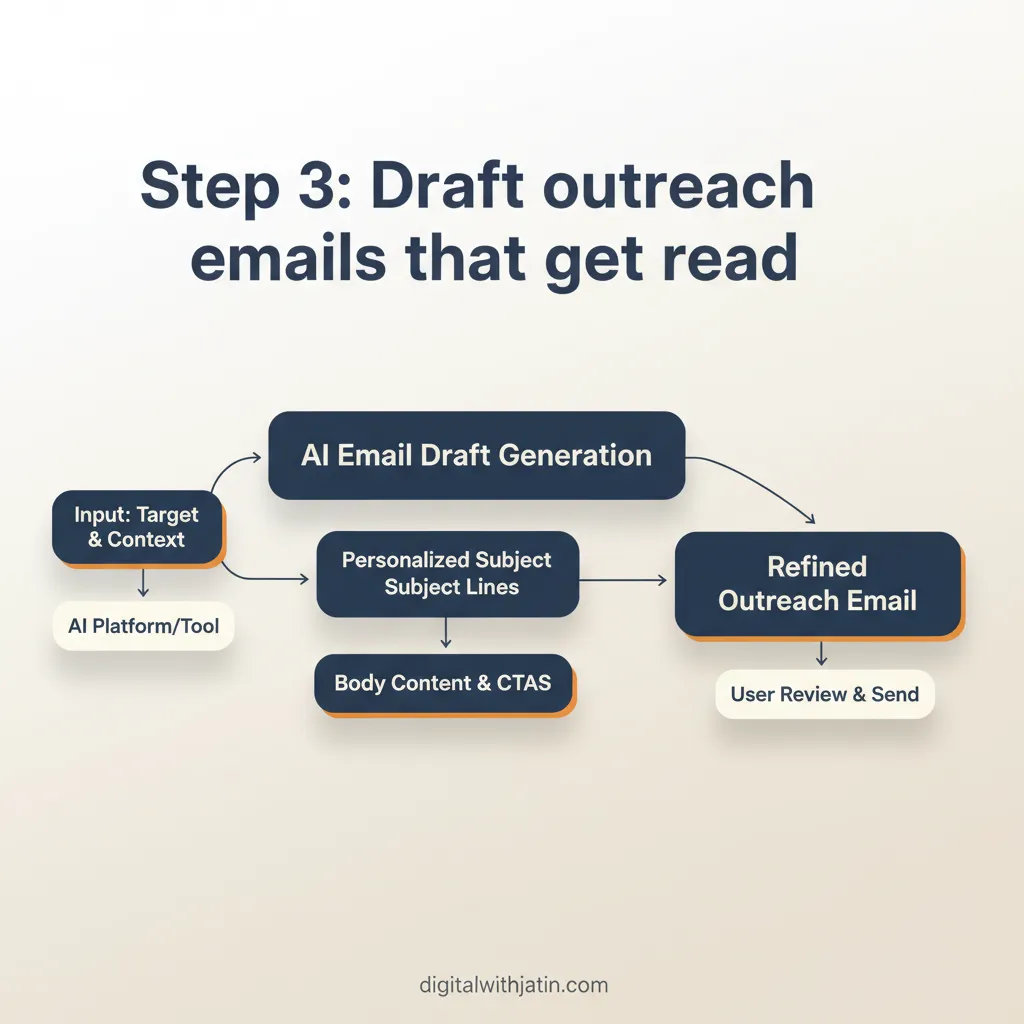
The outreach step is where knowing how to use AI for link building earns its time savings. It works when the model reads the actual target page and drafts a pitch that is specific to that page. Generic outreach AI tools that insert only a name and company into a template are not personalisation. Editors can identify them in seconds.
The workflow: for each of your 30 targets, fetch the referring page URL. Feed the page content and your asset URL to the model with this structure:
You are a link outreach specialist. Read the target page below and write
a personalised outreach email pitching [YOUR CONTENT URL] as a resource
worth linking to.

Rules:
- Under 120 words total
- Reference ONE specific thing from the target page (quote, data point,
  section topic) to show you read it
- Do not use phrases: "I hope this email finds you well", "I came across
  your article", "synergy", "game-changer"
- Subject line under 7 words
- No em dashes
- Sender name: [YOUR NAME]
- Your asset: [TITLE + URL + ONE-LINE DESCRIPTION]

Target page content:
[PASTE PAGE CONTENT OR SUMMARY]
Every draft requires human review before sending. The model produces the first draft; you correct the voice, verify the specific reference is accurate, and add any relationship context you have with the recipient. The human stays in the send loop. This is not optional. An AI that sends outreach autonomously will burn your domain’s sender reputation.
The audit trail matters here too: keep a log of which draft was sent to which URL, on which date, with what subject line. This is the data that tells you which approaches earn replies.
Step 4: Build a follow-up sequence
In most outreach campaigns I’ve run, link placements happen after the first follow-up, not the first email. The follow-up sequence is repetitive to write and easy to draft in bulk with AI.
Write two follow-up variations for each campaign:
5-day nudge (short, no pressure):
Write a follow-up email for a link outreach campaign.
- 5 days after the first email
- Under 50 words
- Tone: brief, friendly, no pressure
- Reference the original email subject
- No new pitch, just checking if they had a chance to review
- No em dashes, no buzzwords
10-day close (give them an easy out):
Write a final follow-up email for a link outreach campaign.
- 10 days after the first email
- Under 45 words
- Tone: respectful close, making it easy to say no
- Something like: "Happy to remove you from follow-ups if
  the timing isn't right"
- No em dashes, no pressure language
Review both drafts. Adjust tone to match your natural voice. A human sends from their inbox on the scheduled day. Do not route this through an automated sending tool unless you have a warm sending domain and a sending reputation you are prepared to manage. Content velocity from AI is only useful if the emails actually reach inboxes.
FAQ
Can AI fully automate link building?
No. Knowing how to use AI for link building means knowing its limits. AI filters targets, drafts outreach emails, and suggests linkable assets. It cannot build the relationships that earn editorial placements, replace journalist contacts for digital PR, or guarantee response rates. Human judgment and relationship-building remain the deciding factors.
What’s the best AI tool for link building research?
For filtering and analysis, ChatGPT (GPT-4o) or Claude Sonnet work well with CSV exports from Ahrefs or Semrush. For prospecting at scale, specialised tools like Pitchbox or Hunter.io have built-in AI features. Start with the combination of a keyword and backlink tool for data and a general LLM for filtering and drafting. The orchestrator does not need to be complex. A spreadsheet and a good prompt template covers most use cases.
How does AI help with link outreach?
AI drafts personalised first-draft emails by reading the target page and generating a relevant pitch. It can produce 30 tailored drafts in the time a human would write 3. Every draft still needs human review for voice, accuracy, and sender-specific context before it goes out. Anthropic’s research on building effective agents frames this as a human-in-the-loop requirement: for consequential external actions (like sending email from your domain), a review gate is not optional.
That first CSV filter step that used to take half a day now runs in four minutes in every client campaign I run. That is where how to use ai for link building actually delivers: compressing the parts of the workflow that are mechanical, repetitive, and do not require relationship context. The four steps above (filter, gap analysis, outreach drafting, follow-up sequencing) are the workflow. Everything else (the reply, the relationship, the editorial judgment) stays with you.
If you want to see how this fits into a broader AI SEO automation system, the pillar covers the full pipeline from keyword research to content to link building. For the agent-specific layer, the AI agents in SEO post covers how to wire these steps into a repeatable workflow. If you want this built for your site, the AI SEO automation service is where we start.