- Structured data labels content blocks so AI retrieval systems can identify what each block is: a question, a step, an article.
- FAQPage and HowTo schema give AI Overviews and Perplexity ready-made citable units they can quote verbatim.
- Schema doesn't guarantee a citation, but it reduces the parsing effort. Pages with valid JSON-LD are more machine-readable.
- Validate every schema with Google's Rich Results Test before publishing.
A client fixed their JSON-LD errors last month. The schema validator finally returned zero warnings. Within three weeks, that page appeared in AI Overviews for two queries it had zero citations for the week prior. Their next question was sharp: does this actually help with AI Overviews, or does it only affect the old-school rich results in classic search?
Understanding how does ai use structured data for seo requires separating two functions schema performs: one for traditional retrieval, one for AI-driven answer generation. The answer is more specific than most SEO guides admit, and the pattern I keep seeing across client audits in India, AU, and US markets points to the same gap each time.
How does AI use structured data for SEO?
AI search systems use structured data as a labeling layer. When your page includes FAQPage or HowTo JSON-LD, the retrieval system can identify which block is a question, which is a procedural step, and which is the main article body. That identification makes it easier to extract and cite specific passages without guessing at content type.
What structured data actually does for AI systems
Schema markup operates on two levels for AI search, and conflating them leads to poor implementation decisions.
The first is the signal layer. Article schema tells crawlers and retrieval systems that a block of text is the primary content body of a page. BreadcrumbList schema confirms the topic hierarchy, which helps AI systems understand whether a page belongs to a broader cluster. These signal-layer schemas do not give AI systems citable units directly. They orient the retrieval system so it understands the page structure before it starts extracting anything.
The second is the content layer. FAQPage and HowTo schema are fundamentally different from Article or BreadcrumbList. They encode self-contained content units directly inside the markup. An FAQPage entry is a complete question-answer pair. A HowTo step is a discrete action with a name and description. AI Overviews and Perplexity can quote these units verbatim because the content itself sits inside structured data, not just pointers to it.
Both layers matter, but they solve different problems. If you add only Article schema and skip FAQPage, you help AI systems understand what your page is, but you do not give them prepackaged citable units. If you add FAQPage without Article, you provide quotable content but weak signals about the overall page context. The combination is stronger than either alone.
Google-Extended and similar crawlers process both layers during indexing. Pages that present clean JSON-LD across both layers tend to have higher indexability for AI-driven features than pages that rely on HTML structure alone.
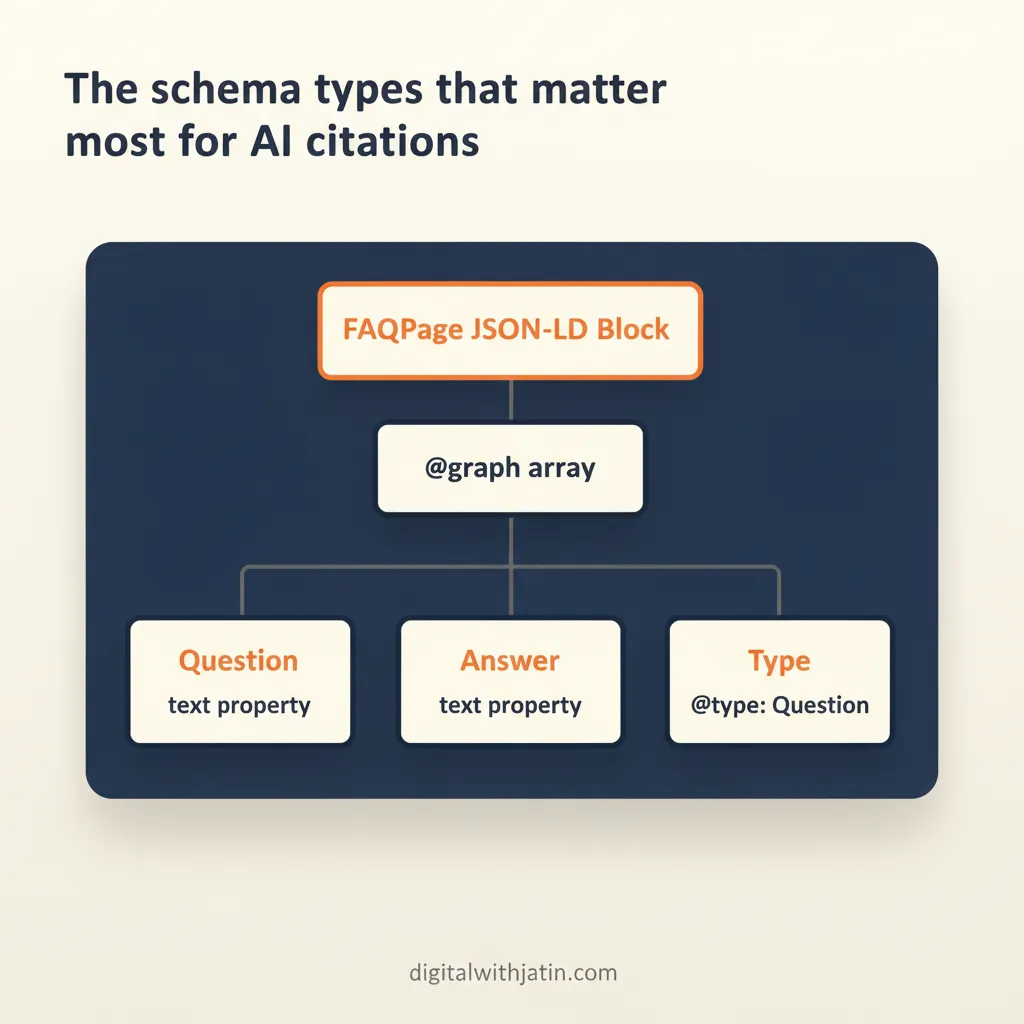
The schema types that matter most for AI citations
Not all schema types contribute equally to AI search visibility. The table below ranks the four most impactful types by what they label and how AI systems use them.
| Schema type | What it labels | AI citation use |
|---|---|---|
| FAQPage | Individual question-answer pairs | AI Overviews and Perplexity quote Q&A entries verbatim as discrete answer units |
| HowTo | Numbered procedural steps with names and descriptions | AI systems present HowTo steps as ready-made procedural sequences in answer blocks |
| Article | The main content body of a page | Orients retrieval systems to the primary passage; supports attribution without providing a prepackaged unit |
| BreadcrumbList | The topic hierarchy from root to current page | Confirms topical authority signals and cluster membership to AI retrieval systems |
FAQPage carries the highest direct citation impact because its structure maps almost exactly to how AI Overviews and Perplexity compose question-driven answers. When a user asks a question that matches one of your FAQPage entries, the AI system has a self-contained answer ready to attribute without needing to parse surrounding prose.
HowTo is particularly effective for procedural queries. If someone asks how to complete a multi-step process, a page with valid HowTo schema gives the AI a clean numbered sequence to present. Pages without HowTo schema often have their steps extracted inconsistently because the AI has to infer step boundaries from prose formatting.
Article and BreadcrumbList are supporting types. They do not directly feed citable units to AI systems, but they reduce ambiguity about what a page is and where it sits in a topic hierarchy. Both are worth implementing on every blog post and landing page that targets informational queries.
For content that answers voice-style queries, SpeakableSpecification is worth researching, though its confirmed impact on AI citation is lower than the four types above.
Three things every page needs before adding FAQPage schema:
- A direct-answer sentence at the top of each section that could stand alone as a quoted passage
- Valid Article JSON-LD in the page head to orient retrieval systems to the page type
- At least one internal link to a related page in the same topical cluster
Does schema guarantee an AI Overview citation?
No. Valid schema reduces friction in the retrieval process, but it does not override the content quality signals that AI systems use when selecting which pages to cite.
Google’s structured data documentation makes this distinction clearly. Schema tells the system what your content is. Helpfulness, authority, and topical depth determine whether that content gets surfaced (Google Search Central, Creating Helpful Content). A page with perfect FAQPage JSON-LD but thin answers will still lose citations to a page with thorough, well-sourced answers and no schema at all.
What schema does is reduce the parsing effort. When two pages cover the same topic at similar quality levels, the page with valid structured data is more likely to be cited because the AI system can locate and extract citable units with less computational work. Think of schema as removing friction from a process that content quality has to justify in the first place.
For AI Overview citations specifically, the pages that appear most consistently tend to combine three things: valid schema (especially FAQPage or HowTo), direct answers placed in the first few sentences of each section, and demonstrated topical depth through internal linking to related content. The AI Technical SEO pillar covers the broader technical signals that support this combination.
How to validate and add schema to any page
Adding schema incorrectly can suppress rich results rather than enable them. Follow these steps to implement it cleanly.
Step 1: Write your JSON-LD block. JSON-LD is the format Google recommends for all structured data. Place it in a <script type="application/ld+json"> tag. Do not embed schema in HTML attributes (Microdata) unless your CMS forces it. The FAQPage type definition on Schema.org lists every supported property. A basic FAQPage block looks like this:
{
  "@context": "https://schema.org",
  "@type": "FAQPage",
  "mainEntity": [
    {
      "@type": "Question",
      "name": "Your question here",
      "acceptedAnswer": {
        "@type": "Answer",
        "text": "Your answer here. Keep it complete and self-contained."
      }
    }
  ]
}
Step 2: Add the block to your page <head>. Place the script tag in the document <head> rather than inline in the body. This ensures crawlers process the structured data before rendering the page.
Step 3: Test with Google’s Rich Results Test. Paste your URL or code into Google’s Rich Results Test after publishing. The tool shows detected schema types, which properties are valid, and which have errors or warnings. Fix every error before considering the implementation complete.
Step 4: Monitor Google Search Console. After the page is indexed, the Enhancements section in Search Console shows structured data health at scale. If new errors appear after a template change, you will see them here before they affect a large portion of your site.
Structured data testing should be part of your publishing checklist, not an afterthought. A single malformed property can invalidate the entire schema block.
FAQ
Does structured data help with AI Overviews?
Yes. Structured data, specifically FAQPage and Article JSON-LD, labels your content so Google’s AI systems can identify what each block is. This makes it easier for AI Overviews to extract and attribute specific passages. Schema is not a citation guarantee, but pages with valid schema are more machine-readable and more likely to be cited.
How does schema markup affect AI SEO?
Schema markup affects AI SEO by making content blocks explicitly typed. An FAQPage schema turns your Q&A section into a machine-readable question-answer list that AI systems can quote directly. HowTo schema turns your numbered steps into a procedural sequence. Both formats map cleanly to how AI search composes its answers.
Does schema help AI search engines like ChatGPT and Perplexity?
Schema helps to the extent that it makes content more parseable. ChatGPT search and Perplexity both crawl pages and extract passages during retrieval. Structured data makes those passages easier to locate and attribute. FAQPage entries in particular are frequently quoted verbatim in Perplexity answers because they are self-contained units.
What schema types matter most for AI search visibility?
In order of impact: FAQPage (direct Q&A citation), HowTo (procedural steps), Article (labels the main content body), and BreadcrumbList (confirms topic hierarchy). SpeakableSpecification is worth adding if your content answers voice-style queries, but it has lower confirmed impact than the first three.
Back to that client who fixed their schema errors. The real answer to their question is that valid structured data made their content more parseable, not just for rich results but for every AI system that crawls and retrieves passages from their pages. Understanding how does ai use structured data for seo comes down to this: schema does not write better content, but it removes the guesswork that AI retrieval systems would otherwise have to do. If your content is strong and your schema is clean, the AI system has less work to do and more reason to attribute the passage to you. If you want help auditing your schema implementation and aligning it with your broader AI search strategy, the AI SEO service covers both.